

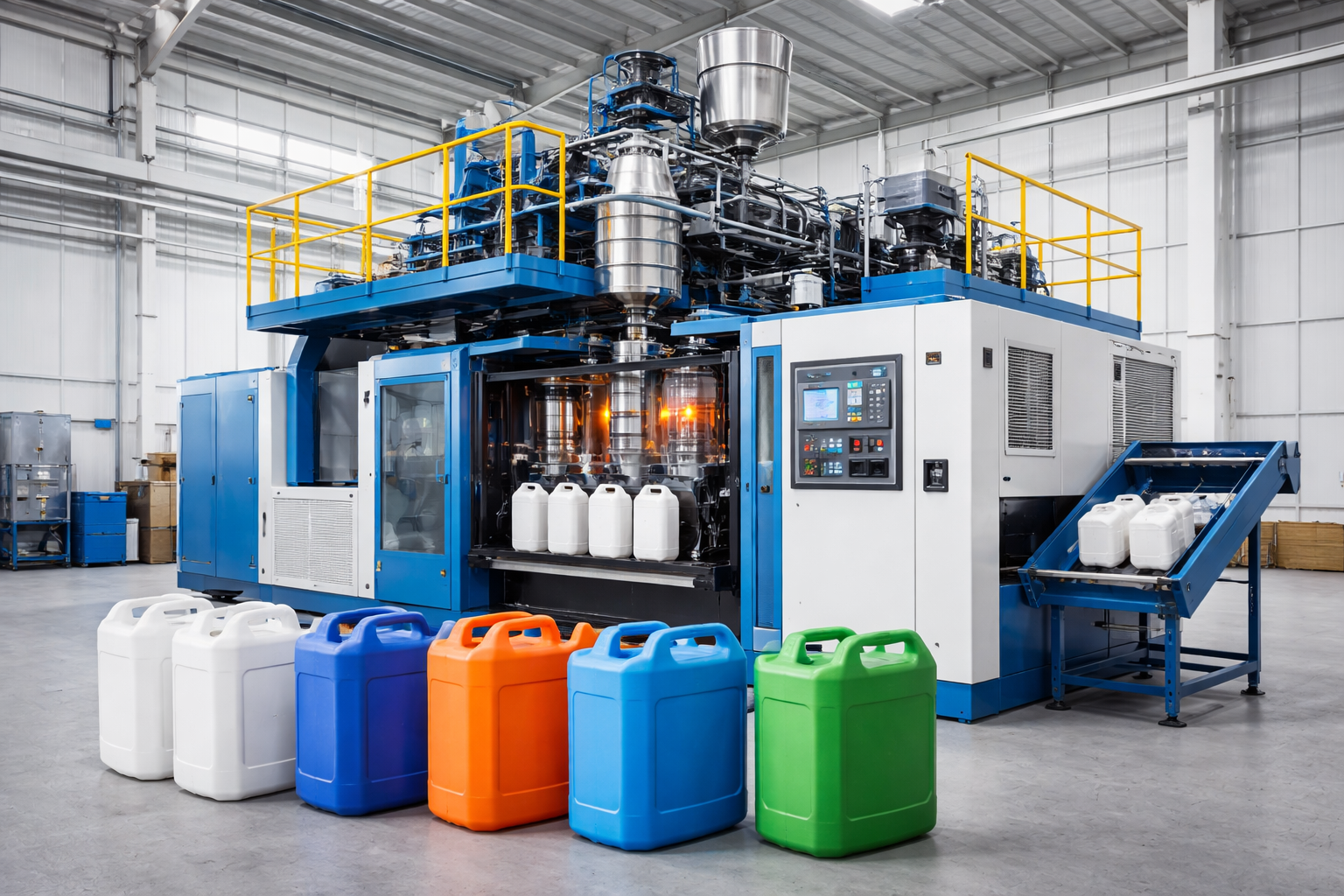
The global demand for industrial packaging is reaching new heights, and at the heart of this growth is the humble yet essential jerrycan. From transporting chemicals and lubricants to storing food-grade oils and potable water, the jerrycan is a staple of logistics. However, for manufacturers, the challenge lies in producing these containers with consistent wall thickness, high durability, and cost-efficiency.
The most critical decision in setting up a successful production line is selecting the right blow molding machine. Choosing a machine isn’t just about the initial price tag; it is about finding a balance between output capacity, material versatility, and long-term energy savings. This guide explores the technical nuances of selecting a blow molding machine specifically optimized for jerrycan manufacturing.
Understanding the Jerrycan Production Requirements
Before evaluating machinery, you must define the specifications of your product. Jerrycans typically range from 2 liters to 30 liters in volume. Unlike lightweight beverage bottles, jerrycans are “industrial” containers, meaning they require high-density polyethylene (HDPE) for strength and chemical resistance.
When you look for a blow molding machine, you must ensure it can handle the high-viscosity resins typical of jerrycan production. Furthermore, because these containers often store hazardous liquids, the structural integrity-specifically the drop-test performance—is non-negotiable. This necessitates a machine that offers precision during the extrusion and blowing phases.
1. Selecting the Right Technology: Extrusion Blow Molding (EBM)
For jerrycan manufacturing, Extrusion Blow Molding (EBM) is the industry standard. In this process, the machine extrudes a hollow tube of molten plastic, known as a parison. A mold then closes around the parison, and compressed air “blows” the plastic into the shape of the mold.
When choosing your equipment, you will likely choose between two configurations:
- Continuous Extrusion: Ideal for smaller jerrycans (up to 5 liters) where a constant flow of plastic ensures high-speed production.
- Accumulator Head Blow Molding: Essential for larger jerrycans (10L, 20L, and 30L). An accumulator head collects a specific volume of molten plastic before pushing it out rapidly to form a large parison. This prevents the plastic from “sagging” due to its own weight, ensuring the top and bottom of the jerrycan have uniform strength.
2. The Importance of Parison Programming
One of the most common issues in jerrycan manufacturing is uneven wall thickness. Because jerrycans have complex shapes including handles and rectangular corners-the plastic naturally thins out in certain areas during the blowing process.
To solve this, a high-quality blow molding machine must be equipped with a parison programmer (often 100-point or 400-point). This technology allows the machine to vary the thickness of the parison as it is being extruded. By making the parison thicker in areas that will be stretched to the corners and thinner in flat areas, you save on raw material costs while significantly increasing the container’s impact resistance. In a competitive market, reducing material usage by even 5% through precise parison control can lead to massive annual savings.
3. Single-Layer vs. Multi-Layer (Co-Extrusion)
The shift toward sustainable and specialized packaging has made multi-layer technology more popular. When choosing your blow molding machine, consider whether you need a single-layer or multi-layer (co-extrusion) setup.
- Single-Layer: Perfect for standard water or oil containers where a single material (HDPE) is sufficient.
- Multi-Layer (3-layer or 6-layer): Necessary for jerrycans storing volatile chemicals or agrochemicals. These machines can sandwich a “barrier layer” (like EVOH or Nylon) between layers of HDPE. This prevents oxygen from entering the container and prevents the contents from seeping through the plastic.
- PCR Integration: Multi-layer machines also allow you to use Post-Consumer Recycled (PCR) plastic in the middle layer while keeping virgin plastic on the inner and outer layers, meeting environmental regulations without compromising the container’s appearance.
4. Clamping Force and Platen Size
The “strength” of a blow molding machine is often measured by its clamping force. For jerrycan production, the mold must be held shut with enough pressure to withstand the high-pressure air used to blow the plastic.
If the clamping force is too low, you will experience “flash” excess plastic leaking from the seams of the mold. This not only wastes material but also increases the workload for the trimming station. Ensure the machine’s platen size is large enough to accommodate the molds for your entire product range. If you plan to produce 20L jerrycans, your machine must have the physical space and hydraulic (or electric) power to secure a mold of that size.
5. Automation and the Production Line
A modern jerrycan production line is rarely just the blow molding machine itself. To maximize ROI, look for machines that support “downstream” automation. This includes:
- Automatic Deflashing: The machine should automatically trim the excess plastic from the handle and the bottom of the jerrycan.
- In-Mold Labeling (IML): Some machines allow labels to be placed inside the mold before blowing, fusing the label directly into the plastic.
- Leak Testing: An integrated leak tester ensures that every jerrycan leaving the line is airtight, which is critical for industrial safety standards.
6. Energy Efficiency: Electric vs. Hydraulic
With rising energy costs, the power consumption of your blow molding machine is a major factor in your “Cost Per Piece.”
- Hydraulic Machines: Historically the standard for large jerrycans due to their high clamping force. Modern versions now use servo-motors to reduce energy waste during idle times.
- All-Electric Machines: These are becoming increasingly common for jerrycans up to 10 liters. They are cleaner (no oil leaks), quieter, and can reduce energy consumption by up to 40% compared to traditional hydraulic systems.
7. Evaluating the Total Cost of Ownership (TCO)
When you are ready to make a purchase, look beyond the initial quote. A cheap blow molding machine may end up being the most expensive if it suffers from frequent downtime or requires specialized parts that are hard to source. Ask the manufacturer about cycle times, ease of mold changeover, and the availability of local technical support.
Frequently Asked Questions (Industrial Insights)
What is the best material for jerrycan manufacturing?
High-Density Polyethylene (HDPE) is the preferred material due to its excellent strength-to-density ratio, chemical resistance, and impact durability. For specialized chemical storage, a multi-layer blow molding machine may be used to add a barrier layer of EVOH.
How does an accumulator head benefit large jerrycan production?
For containers over 10L, a standard continuous extrusion can lead to “parison stretch,” where the plastic thins out at the top due to gravity. An accumulator head stores the melt and ejects it all at once, ensuring a uniform parison weight and superior structural integrity.
Can I use recycled plastic in my blow molding machine?
Yes, modern machines are designed to handle Post-Consumer Recycled (PCR) resins. Using a co-extrusion (multi-layer) machine is the most efficient way to do this, as it allows you to hide the recycled material in a middle layer between two layers of virgin plastic.
What is the average cycle time for a 20L jerrycan?
Cycle times vary based on the machine’s cooling capacity and automation features, but typically, a 20L jerrycan takes between 45 to 90 seconds to produce. High-end machines with optimized cooling systems can significantly reduce this time.
Is an all-electric blow molding machine powerful enough for industrial jerrycans?
While hydraulics were once the only option for high clamping forces, modern all-electric machines are now capable of producing jerrycans up to 10-20 liters with high precision and significantly lower energy costs.
Conclusion
Choosing a blow molding machine for jerrycan manufacturing is a high-stakes investment. By focusing on Extrusion Blow Molding technology with advanced parison programming and considering the benefits of multi-layer co-extrusion, you can ensure that your containers meet the rigorous demands of the industrial market. Prioritizing energy efficiency and automation will not only lower your overhead but also position your facility as a leader in sustainable, high-tech plastic manufacturing.

Discover Modern Comfort: A Guide to Apartment Rent in Beirut
Beirut, the lively capital of Lebanon, is a city that blends deep-rooted history with a mo…



Discover Modern Comfort: A Guide to Apartment Rent in Beirut
Beirut, the lively capital of Lebanon, is a city that blends deep-rooted history with …