

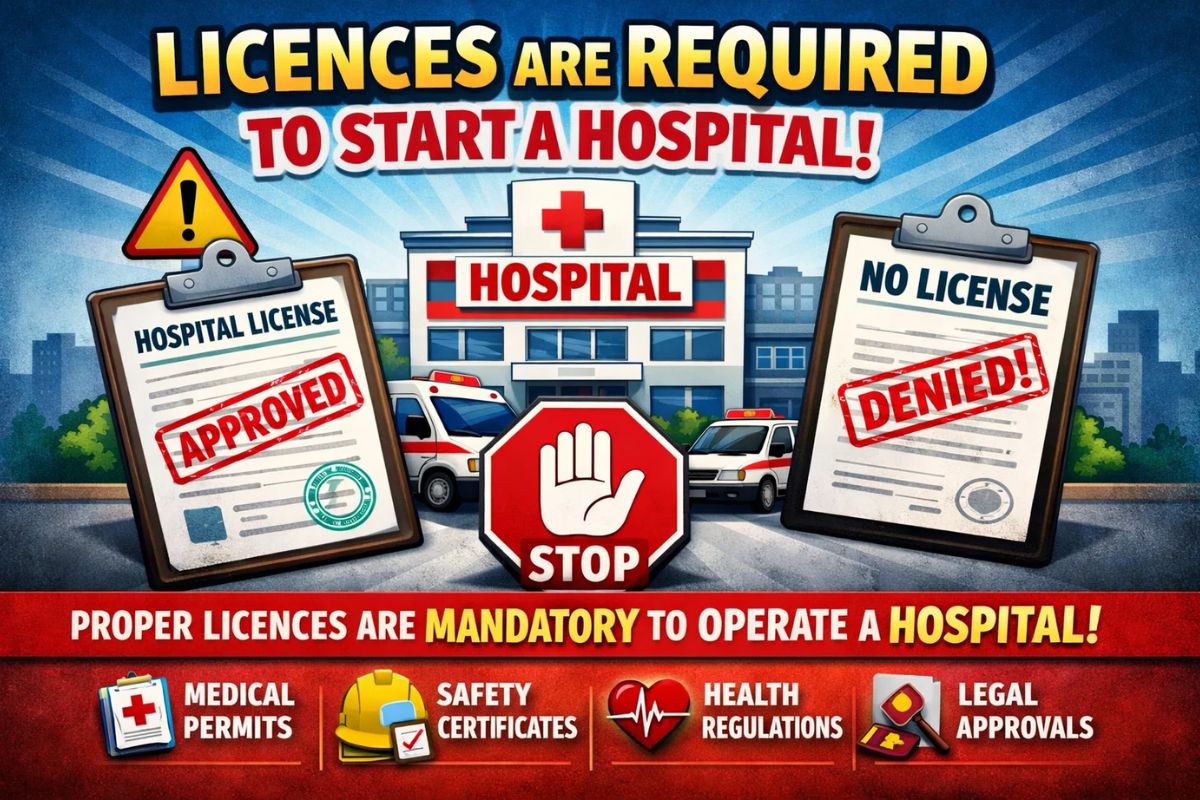
Starting a hospital in Tamil Nadu is a regulated process that requires multiple licenses from various authorities, including those for healthcare, environment, fire safety, and local government. All of these licenses exist to protect the safety of patients, to ensure the future hospital will be conducted responsibly for the environment, to ensure ethical conduct in providing medical care, and to guarantee that the future hospital will comply with all applicable laws.
All clinics, nursing homes, or hospitals (large and small) must obtain the required statutory approvals prior to being able to legally operate. The specific Licenses Required to Start a Hospital vary according to several different factors, including bed strength, building size, medical services being provided, and types of diagnostic and/or treatment services being provided.
This section will identify and describe all licenses necessary to establish a hospital in Tamil Nadu. Licenses will be classified into Core Mandatory Licenses and Service Specific Conditional Licenses.
Core Mandatory Licenses for All Hospitals
Every hospital must possess the following Core Mandatory Licenses regardless of its size or specialty.
- Clinical Establishment Registration
This is the License to operate in Tamil Nadu as a legally recognized healthcare provider as per the laws of the State.
- Licensing Authority
- Directorate of Medical Services (DMS) for Private Facilities
- Directorate of Medical Education (DME) for Teaching Facilities
- What is the Purpose of the License
- Establishes Legal Status of the Hospital
- Specifies Bed Strength and Services
Verifies Qualifications of the Doctors, Number of Employees and provides a list of employees (as required by the licensing authority)
- Tamil Nadu Pollution Control Board (TNPCB) Approval
All hospitals must have Environmental Clearance because they generate biomedical waste and release sewage into the environment.
(a) “Consent to Establish” (CTE) must be obtained before any equipment is installed for operation.
CTE is assessed based on bed strength, STP capacity, DG Sets and waste generation.
(b) “Consent To Operate” (CTO) must be obtained before admitting patients to the hospital.
CTO is granted to the DTO applicant after the inspection of compliance with applicable regulations.
- Biomedical Waste Management Authorisation
The hospital has to comply with “Biomedical Waste Management Rules, 2016”.
Main criteria include:
- Authorised by TNPCB
- An Agreement with an authorised biomedical waste disposal agency
- A colour-coded waste segregation system
- Trained staff and documented SOPs
This authorisation will be strictly checked during inspections.
- Fire Safety Certificate
All hospitals must obtain a fire safety certificate for safety reasons due to high occupancy rates of patients and the requirement of life support systems.
The following hospitals require a Fire Safety Certificate:
- Hospitals with greater than 10 bed capacity
- Multi-storey hospitals
- Hospitals with an ICU, OT and/or oxygen storage
The Fire Safety Certificate will be issued by the Tamil Nadu Fire & Rescue Services Department.
All hospitals will be required to receive a final fire safety certificate prior to the commencement of operations.
- Local Body Trade License
A local body trade license allows the hospital to carry out business in the area of local jurisdiction.
A trade license must be obtained from the following entities:
- Local Municipals
- Corporation
- Panchayat
The entities will only approve if all of the Statutory Clearances have been examined and verified.Infrastructure and Location-Specific Approvals
The Infrastructure and Location-Specific Approvals validate the physical legality and safety of the hospital premises.
Land Use and Zoning Approvals
Hospitals can operate on land that has been approved for medical use/institutional use.
- Approving Authorities
- CMDA – Chennai Metropolitan Area
- DTCP – Other Districts
Written proof of ownership or lawful possession of the land is a prerequisite for obtaining a Land Use or Zoning Approval.
Building Plan Approvals
A Hospital’s Building Plan must be in compliance with the National Building Code (NBC), Local Development Regulations, and Accessibility and Emergency Movement Standards. Local Authority Approval will be required for each of these items.
Medical Service Licences – Conditional
A Hospital must obtain additional Licences depending on the type of Medical Services it wishes to offer (in addition to core licences) prior to commissioning those Services:
- X-ray, CT Scan and MRI – AERB Licence by the Atomic Energy Regulation Board.
- Blood Bank Licence – Licence by the Drug Controller for Blood Banks.
- Oxygen Storage Licence – PESO Licence from the Petroleum and Explosives Department.
- In-House Pharmacy – Drug Licence from the Drug Control Department.
- Lifts – Lift Safety Certificate from the Electrical Inspectorate.
- Labour Room – Maternity Registration from the Health Department.
Not obtaining a Medical Service Specific Licence can lead to suspension of the Department providing that Service – even if the Hospital has obtained all Core Approvals.
Importance Of Licenses for Hospitals
Licensing is not an administrative formality for hospitals, rather licensing is to;
- Ensure appropriate care for patients in addition to ensuring patient safety,
- Provide legal protection for the promoters and medical staff,
- Ensure compliance with the standards of public safety, health, and the environment,
Create and establish trust and credibility in the healthcare community, as well as among facility and services regulators.
Non-licensed hospital operations may result in penalties, lawsuits, or mandatory closures.
Conclusion:
To open a new hospital in Tamil Nadu, you will need to obtain multiple types of licenses through the healthcare, environmental, fire safety, and local authorities. Though the process may appear confusing, it can be simplified by obtaining and submitting the appropriate approval documentation in the correct sequence.
By being fully compliant with all regulatory agency requirements, you can have a legally operating hospital and may be viewed by potential patients as a safe, credible, and properly-managed healthcare facility.


Discover Modern Comfort: A Guide to Apartment Rent in Beirut
Beirut, the lively capital of Lebanon, is a city that blends deep-rooted history with a mo…



Discover Modern Comfort: A Guide to Apartment Rent in Beirut
Beirut, the lively capital of Lebanon, is a city that blends deep-rooted history with …