

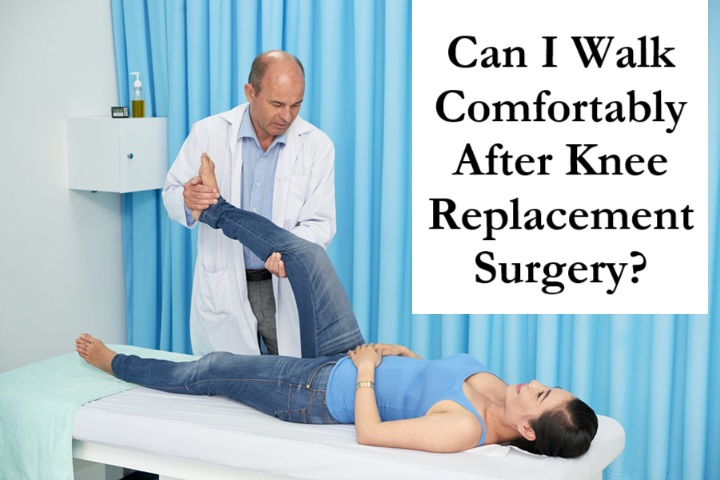
Knee replacement surgery has changed the lives of many patients with excruciating and debilitating knee pain. After the surgery, life improves and becomes comfortable. The person starts to walk pain-free and is able to do all regular activities that are essential without any discomfort.
Overview
Many patients suffer from chronic and debilitating knee pain. The situation becomes so bad that the affected person cannot even walk a few steps without discomfort. Mobility gets severely hampered.
For such patients, the primary goal of knee replacement surgery is to restore mobility.
Gradually, the excruciating knee pain subsides, helping the patient transition back to comfortable walks and independent living.
Patients don’t have to be bedridden for long, abstaining from walking. Instead, it is the reverse. A patient is encouraged to walk early within 24 hours of surgery. It is a crucial part and requirement of the rehabilitation programme.
Early ambulation (or moving the operated knee joint) prevents blood clotting and contributes to optimal mobility restoration. Walking assistance is also ensured at this phase for needy patients like a patient care professional or walking devices such as crutches, walkers, canes etc.
Thus, every patient can walk comfortably after knee replacement surgery; this is the main purpose of receiving this treatment.
Knee Anatomy
The knee is a hinge joint which might offer a simplistic view on the outside but is made up of various intricate and interconnected internal parts as mentioned below.
- Bone Ends (The Femur, The Tibia, & The Kneecap or The Patella)
- Articular Cartilage
- Meniscus
- Bursa
- Ligaments
- Tendons
- Synovial Membrane
- Muscles
- Nerves
In short, these parts are classified as bony structures and soft tissues.
Knee Replacement Surgery
Knee replacement surgery is only recommended when major knee parts are damaged or worn out. Various conditions like osteoarthritis, rheumatoid arthritis, osteonecrosis, deformities, or injuries are responsible in this regard. The affected person has to deal with extreme walking issues. Life becomes dependent and sedentary.
In this intervention, problematic or degenerated regions of the knee are removed or chiselled away. Then, with the help of an implant, resurfacing is performed. It is a procedure to reconstruct dysfunctional parts so the knee can regain the full range of motion and work as it used to.
Furthermore, there is robotic technology or AR technology. These recently evolved technologies help achieve high accuracy and precision. If you have concerns regarding this procedure, meet with a top orthopedic surgeon in Delhi. Book your appointment today.
Recovery
The exact time varies from one patient to another. The recovery after knee replacement surgery isn’t the same for everyone. There are a number of factors that influence duration. For example, if someone is suffering from comorbid conditions, the recovery might linger longer than in the case of a healthy patient.
Yet, on average, it requires 4 to 6 weeks for complete recovery for most healthy patients. The surgery of total knee replacement is complete in 1 to 2 hours. The discharge from the hospital usually happens after 4 or 5 days of hospital stay. Stitches are removed 14 days from the date of the surgery.
The physiotherapist continues to work on knee strengthening and mobility. Minor pain and swelling in the operated knee gradually subsides within 3 to 4 weeks and the patient starts walking freely.
Is Knee Replacement Surgery Safe?
Yes, knee replacement surgery is a safe and successful procedure. Consider the following points.
Advanced Technologies: There are technologies available to make joint replacement surgeries accurate, precise and effective. They are robotic technology and AI-based AR-assisted technology.
Pre-operative Checks: Before the surgery, a variety of tests are ensured to check for certain conditions that might need special attention. These tests help make sure that everything is okay with the physical body of the patient and that the surgeon can proceed with knee replacement surgery safely.
These checks usually include:
- Physical Evaluation
- Blood Tests
- Electrocardiogram
- Chest X-rays
- Urine Tests
Muscle Strengthening: Before and after the surgery, the patient is provided physiotherapy to help strengthen weak muscles. Patients who have lived a sedentary lifestyle need physiotherapy most.
Pain Management: The patient requires pain control after the completion of the operation. The surgeon prescribes medicines that help reduce post-operative inflammation and discomfort.
Post-Operative Care: The patient is instructed to walk early either independently or with the help of assistance. Some patients don’t need external aid while others do.
If the patient cannot walk due to being obese or for any reason, Intermittent Pneumatic Compression (IPC) devices are employed to prevent blood clotting. The concerned limb is pressurised/squeezed at frequent intervals to keep the blood circulation at the optimal level.
The use of intermittent pneumatic compression is quite rare because most patients start to walk on their own or with a little support after 24 hours comfortably, and even begin to climb stairs in 2 to 3 days.
Furthermore, during the hospital stay, the patient is provided with periodical medical examinations to check for any signs of complications. Physiotherapists and occupational therapists are also available to
- work on weak muscles
- help transition back to a regular lifestyle
- improve mobility and quality of life
Follow-up consultations continue even after the discharge from the hospital.
So, knee replacement surgery is quite safe, considering all these crucial patient-care aspects associated. If you need surgery for your painful knees, don’t delay to make the internal conditions worse. Connect with the best doctor for robotic knee replacement.
Conclusion
One can comfortably walk after knee replacement surgery—the primary purpose of the intervention. It is performed so a person with intense knee pain and consequent disability can walk pain-free. Within 24 hours, the patient is encouraged and supported to stand and start walking.
This is a safe and totally successful procedure. Technology has also dramatically advanced to make the procedure even more personalised, precise and accurate, for example, robotic technology or AI-based AR-assisted technology.
Discover Modern Comfort: A Guide to Apartment Rent in Beirut
Beirut, the lively capital of Lebanon, is a city that blends deep-rooted history with a mo…



Discover Modern Comfort: A Guide to Apartment Rent in Beirut
Beirut, the lively capital of Lebanon, is a city that blends deep-rooted history with …