


Planning to migrate to Australia through skilled migration? Understanding the 491 visa processing time is crucial for planning your future. In this guide, we’ll break down everything you need to know about timelines, costs, and what affects how long your application takes.
What Is the Subclass 491 Visa?
The Subclass 491 is a skilled migration visa that allows you to live, work, and study in a designated regional area of Australia for up to five years. It’s sponsored by a state or territory government, or by an eligible family member. Unlike permanent visas, the 491 visa is provisional, but it offers a clear pathway to permanent residency through the Subclass 191 Visa after three years.
The key advantage? It’s more accessible than other skilled migration options because regional areas have lower competition for nominations.
491 Visa Processing Time: What to Expect in 2026
So, how long does the 491 visa processing take? The answer depends on several factors, but here’s the realistic timeline you should prepare for.
Standard 491 Processing Time
The typical 491 visa processing time ranges from 6 to 17 months from start to finish. However, this includes the state nomination phase, which can be unpredictable.
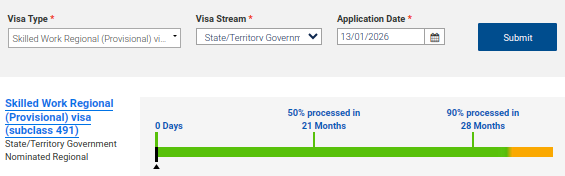
Here’s how to break it down:
- State Nomination: 4-12 weeks (varies significantly by state)
- Invitation to Apply (ITA): Typically issued within weeks of nomination approval
- Visa Application Processing: 3-6 months for standard applications
- Health & Character Checks: 2-8 weeks (can overlap with application processing)
491 Subsequent Entrant Processing Time
If you’re applying as a dependent family member (spouse or child) in someone else’s 491 application, your processing time is generally faster. Subsequent entrants typically process within the same timeframe as the primary applicant, as their documentation is assessed together. However, any issues with your police clearances or medical checks can extend this timeline.
491 Visa Processing Time Offshore vs Onshore
Offshore Applications: If you’re applying from outside Australia, your processing typically takes the full 6-14 months. You’ll need to complete all health and character checks before arrival, which can add 2-3 months.
Onshore Applications: If you’re already in Australia on another visa, processing may be slightly faster (6-10 months) because some checks can be completed more quickly.
Factors Affecting Your 491 Processing Time
Not all applications move at the same speed. Several factors influence how long your visa 491 processing time will be:
State Nomination Delays
This is the biggest variable. Different states have different processing times:
- NSW & Victoria: 8-12 weeks
- Queensland & WA: 6-10 weeks
- South Australia & Tasmania: 4-8 weeks
- Less Popular States: Sometimes faster due to lower demand
Application Completeness
Incomplete applications are the number one cause of delays. Missing documents, inconsistent information, or unclear evidence can trigger requests for further information. Each request adds 2-4 weeks to your timeline.
Skills Assessment Status
Your skills assessment must be current and positive before you can receive an invitation. Assessment bodies typically take 4-8 weeks to assess your qualifications and work experience.
Health & Character Checks
Medical examinations and police clearance certificates are part of the process. If you need to arrange these from multiple countries or have a complex health history, this can extend your timeline by several weeks.
Document Preparation
Quality preparation matters. Applicants who submit well-organised, comprehensive documentation with clear evidence of their claims move through the system faster.
How to Apply for the 491 Visa
Understanding the step-by-step process helps you plan your timeline more accurately.
Step 1: Check Your Eligibility
Ensure your occupation is on the Skilled Occupation List (SOL) for your chosen state or territory. Not all occupations are in demand in all regions.
Step 2: Gather Your Skills Assessment
Submit your qualifications and work experience to the appropriate assessing body for your occupation. This typically takes 4-8 weeks and must be completed before state nomination.
Step 3: Apply for State Nomination or Family Sponsorship
Submit an Expression of Interest (EOI) to your chosen state, or arrange sponsorship from an eligible family member. This is where the timeline can vary significantly depending on demand.
Step 4: Receive Your Nomination Approval
Once the state approves your nomination, you’re eligible to receive an invitation to apply from the Department of Home Affairs.
Step 5: Receive Your Invitation to Apply (ITA)
After state nomination approval, you’ll receive an ITA. You then have 60 days to submit your full visa application.
Step 6: Lodge Your Visa Application
Submit your complete application through ImmiAccount with all supporting documents. This is critical—incomplete applications will be returned and cause delays.
Step 7: Complete Health & Character Checks
Arrange your medical examination with an approved panel doctor and obtain police clearances from all countries where you’ve lived.
Step 8: Receive Your Visa Decision
Once all checks are complete, the Department of Home Affairs will decide on your application.
Common Reasons for 491 Visa Refusals
Understanding what can go wrong helps you avoid costly delays and rejections.
Failed State Nomination
Each state has specific requirements. If you don’t meet occupation demand, points requirements, or state-specific criteria, your nomination will be rejected.
Incomplete or Incorrect Documentation
Inconsistent information across documents, missing evidence, or poor-quality supporting materials frequently lead to refusals. Take time to prepare comprehensive documentation.
Unsuccessful Skills Assessment
Your skills assessment must be positive. If the assessing body determines your qualifications or experience don’t match the occupation standards, you won’t be eligible.
English Language Deficiency
Many occupations require a minimum IELTS or PTE score. If you don’t meet the requirement, your application will be refused.
Low Points Score
Although the minimum is 65 points, having only 65 points means you’re competing against many others. A score of 80+ points significantly improves your chances of receiving an invitation faster.
Medical or Character Issues
Pre-existing health conditions or criminal history can affect your outcome. These aren’t automatic refusals, but they require careful handling.
Errors in Your Expression of Interest
Mistakes in your EOI—wrong occupation code, incorrect state selection, or inaccurate points claims—can result in disqualification.
How to Speed Up Your 491 Visa Processing Time
While you can’t officially fast-track your application, several strategies can help you move through the process more efficiently.
Choose the Right State
Different states have different processing times and demand levels. Research which state needs your occupation and has reasonable processing timelines. South Australia and Tasmania often process nominations faster than New South Wales or Victoria.
Achieve a Strong Points Score
Aim for 80+ points rather than just meeting the minimum of 65. A higher score increases your chances of receiving an invitation in the next invitation round.
Prepare Complete Documentation
Invest time in gathering comprehensive, well-organised evidence. Clear documentation reduces requests for further information and speeds up assessment.
Obtain Your Skills Assessment Early
Don’t wait until after state nomination approval. Complete your skills assessment early so you’re ready to apply immediately when nominated.
Submit Health & Police Checks Promptly
As soon as you receive your invitation, arrange your medical examination and police clearances. Don’t wait until the last moment—these checks take time and can cause delays.
Choose the Right Assessing Body
Use the correct skills assessment body for your occupation. Using the wrong body can result in an unsuccessful assessment.
Stay Organised and Track Your Application
Regularly check ImmiAccount for updates. Respond promptly to any requests for information from the Department of Home Affairs.
491 Visa FAQs: Processing Time & Beyond
What is the typical 491 processing time in 2026?
The 491 visa processing time usually ranges from 6 to 14 months, depending on state nomination speed and document completeness. The state nomination phase is often the longest component.
Is 75 points enough for a 491 visa?
While the minimum is 65 points, 75 points is reasonable but not optimal. Aiming for 80+ points increases your chances of receiving an invitation faster, as you’ll compete more favourably against other applicants.
Can I include my family in my 491 visa application?
Yes! You can include your spouse or de facto partner, dependent children under 18, and children over 18 if they’re financially dependent on you. Including family members increases the overall application cost but allows your family to migrate together.
What happens if my application is delayed?
Delays can occur due to state nomination processing times, background checks, or incomplete documentation. Track your application status regularly through ImmiAccount. Contact your state sponsorship authority if delays exceed expected timeframes.
Is the 491 visa permanent?
No, the 491 visa is provisional, valid for five years. However, it provides a clear pathway to permanent residency. After three years of living in a designated regional area and meeting income requirements, you can apply for the Subclass 191 Visa for permanent residency.
What if my 491 visa application is refused?
You have options. You can appeal through the Administrative Appeals Tribunal (AAT) or submit a new application with stronger documentation. Consult with a migration professional to understand your best course of action.
What’s the difference between 491 processing time offshore and onshore?
Offshore applications (from outside Australia) typically take 6-14 months as all health checks must be completed before arrival. Onshore applications (while in Australia) may be slightly faster (6-10 months) because medical assessments can be arranged more quickly within Australia.
In Conclusion
The 491 visa processing time doesn’t have to feel like a mystery. By understanding the timeline, preparing thoroughly, and choosing the right state, you can navigate the process more confidently. Most applicants receive their visa within 6-14 months, and many receive it faster by taking a strategic, organised approach.
The key is starting early, gathering complete documentation, and staying informed throughout your application journey. If you need guidance navigating the 491 visa process, registered migration agents in Perth and across Australia can provide expert support to ensure your application succeeds.
Ready to begin your 491 visa journey? Start by checking your occupation eligibility and researching state options today.

Discover Modern Comfort: A Guide to Apartment Rent in Beirut
Beirut, the lively capital of Lebanon, is a city that blends deep-rooted history with a mo…



Discover Modern Comfort: A Guide to Apartment Rent in Beirut
Beirut, the lively capital of Lebanon, is a city that blends deep-rooted history with …