

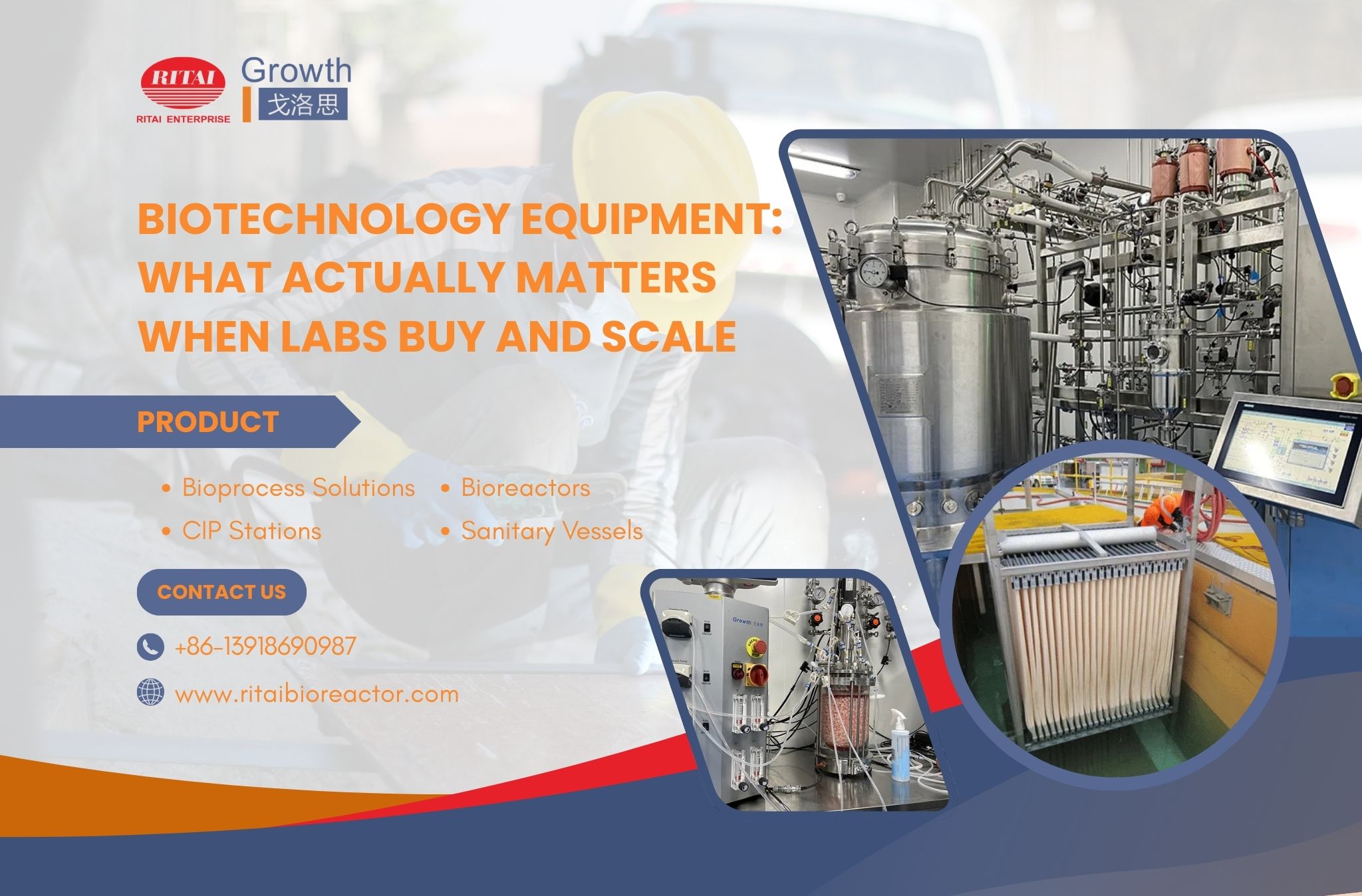
People outside the lab often treat Biotechnology Equipment as a shopping list: bioreactors, filters, sensors, controllers. Anyone who has worked inside a real facility knows that view is far too simple. Equipment decisions shape how experiments behave, how smoothly scale-up goes, and how often teams end up firefighting instead of doing science.
In practice, buying biotechnology equipment is less about specs and more about how systems behave at 2 a.m. when something drifts out of range. That’s where experience—not marketing—starts to matter.
How Labs Really Define Biotechnology Equipment
On paper, biotechnology equipment covers everything used to grow, process, and analyze biological material. In real labs, the definition is more practical. It’s the hardware that either keeps runs stable or forces constant intervention.
Most teams think in terms of workflows, not product catalogs. A bioreactor isn’t judged on capacity alone. It’s judged on how predictable it is, how easy it is to clean or turn over, and how much attention it demands during a long run. This is why experienced labs rarely switch equipment vendors casually. Once a system proves reliable, it becomes part of the lab’s muscle memory.
Why Bioreactors Carry More Risk Than Any Other System
Among all biotechnology equipment, bioreactors carry the most operational risk. They sit at the center of upstream processing, where small deviations can cascade into failed batches. Operators notice this quickly. A slightly inconsistent oxygen probe or uneven mixing doesn’t show up in brochures, but it shows up in growth curves. Over time, teams learn which design shortcuts cause problems and which manufacturers think through real operating conditions. This is where differences between Bioreactor Manufacturers become obvious. Some focus on selling vessels. Others focus on selling stability.
What Separates Reliable Bioreactor Manufacturers From the Rest
Veteran buyers evaluate bioreactor manufacturers differently than first-time purchasers. They look beyond vessel size and ask uncomfortable questions:
- How often do sensors drift during extended campaigns?
- How much operator input is required during steady-state operation?
- What breaks first after three years of daily use?
Manufacturers who have spent time inside production environments tend to design equipment that answers those questions quietly. Control loops behave consistently. Spare parts are standardized. Documentation matches reality instead of theory. That kind of reliability is hard to fake.
Single-Use Systems: Useful, Not Magical
- Single-use bioreactors have earned their place in modern biotechnology equipment setups, especially in development and multiproduct facilities. Faster turnaround and reduced cleaning validation are real advantages.
- That said, experienced teams are clear-eyed about the trade-offs. Consumable costs rise quickly. Waste streams grow. And not all single-use systems behave consistently at higher working volumes.
- Most labs that scale successfully treat single-use as a tool, not a philosophy. Early work happens fast. Proven processes eventually move to more permanent systems. Good bioreactor manufacturers support both paths without forcing one narrative.
Stainless Steel Still Dominates at Scale
- Despite years of hype around disposables, stainless steel bioreactors remain the backbone of large-scale production. The reasons are practical, not nostalgic.
- Steel systems tolerate aggressive cleaning, long campaigns, and repeated thermal cycles. When maintained properly, they last decades. For companies planning commercial production, this matters.
- Here again, biotechnology equipment choices reflect long-term thinking. Facilities that plan for ten years ahead rarely regret investing in robust infrastructure.
Automation Isn’t Optional Anymore
- Modern biotechnology equipment is judged as much on software as on hardware. Manual control belongs in small research labs, not production environments.
- Data integrity, alarm management, and audit trails matter daily, not just during inspections. Bioreactors that integrate cleanly with plant control systems reduce operator workload and error rates.
- This is an area where some bioreactor manufacturers still lag. Systems that require custom scripting or fragile interfaces slow teams down. The best vendors design controls that feel boring—in a good way.
Scaling Reveals Design Shortcuts
- Scaling exposes weaknesses that never appear at benchtop level. Mixing patterns change. Heat removal becomes uneven. Sensors respond more slowly.
- Experienced teams choose biotechnology equipment that behaves predictably across scales. They expect manufacturers to provide real scale-up data, not just theoretical models.
- Bioreactor manufacturers who invest in scale-down testing earn trust quickly. They help teams anticipate problems before they show up in production.
Maintenance and Support Decide Long-Term Value
Sticker price fades fast. Downtime does not.
- Labs learn this lesson the hard way when spare parts take weeks to arrive or service teams lack process knowledge. Biotechnology equipment that cannot be maintained easily becomes a liability.
- The best manufacturers design systems with maintenance in mind. Components are accessible. Parts are standardized. Software updates don’t break existing workflows.
- These details never make headlines, but they determine whether equipment becomes an asset or a headache.
Why Documentation Is Part of the Equipment
In regulated environments, documentation is not an accessory. It is part of the biotechnology equipment itself. Validation protocols, material traceability, and change control records shape how smoothly audits go. Bioreactor manufacturers who provide clear, consistent documentation save teams countless hours. Labs remember this. Vendors who treat compliance seriously tend to build long-term relationships.
Choosing Biotechnology Equipment With Experience, Not Hype
- The most successful labs make equipment decisions slowly and deliberately. They involve operators early. They test assumptions. They talk to other users, not just sales teams.
- Strong partnerships with trusted bioreactor manufacturers reduce friction as processes evolve. Equipment ages. Processes change. Regulations tighten. Vendors who stay engaged remain relevant.
Closing Perspective
Good Biotechnology Equipment does its job quietly. It supports stable processes, reliable data, and predictable scale-up. When chosen with experience and realism, it disappears into the background and lets teams focus on outcomes. Understanding how Bioreactor Manufacturers think—about design, support, and long-term use—helps labs avoid costly mistakes. In biotechnology, the smartest equipment decisions are rarely flashy. They are simply the ones that keep working year after year.
Discover Modern Comfort: A Guide to Apartment Rent in Beirut
Beirut, the lively capital of Lebanon, is a city that blends deep-rooted history with a mo…



Discover Modern Comfort: A Guide to Apartment Rent in Beirut
Beirut, the lively capital of Lebanon, is a city that blends deep-rooted history with …