

Introduction
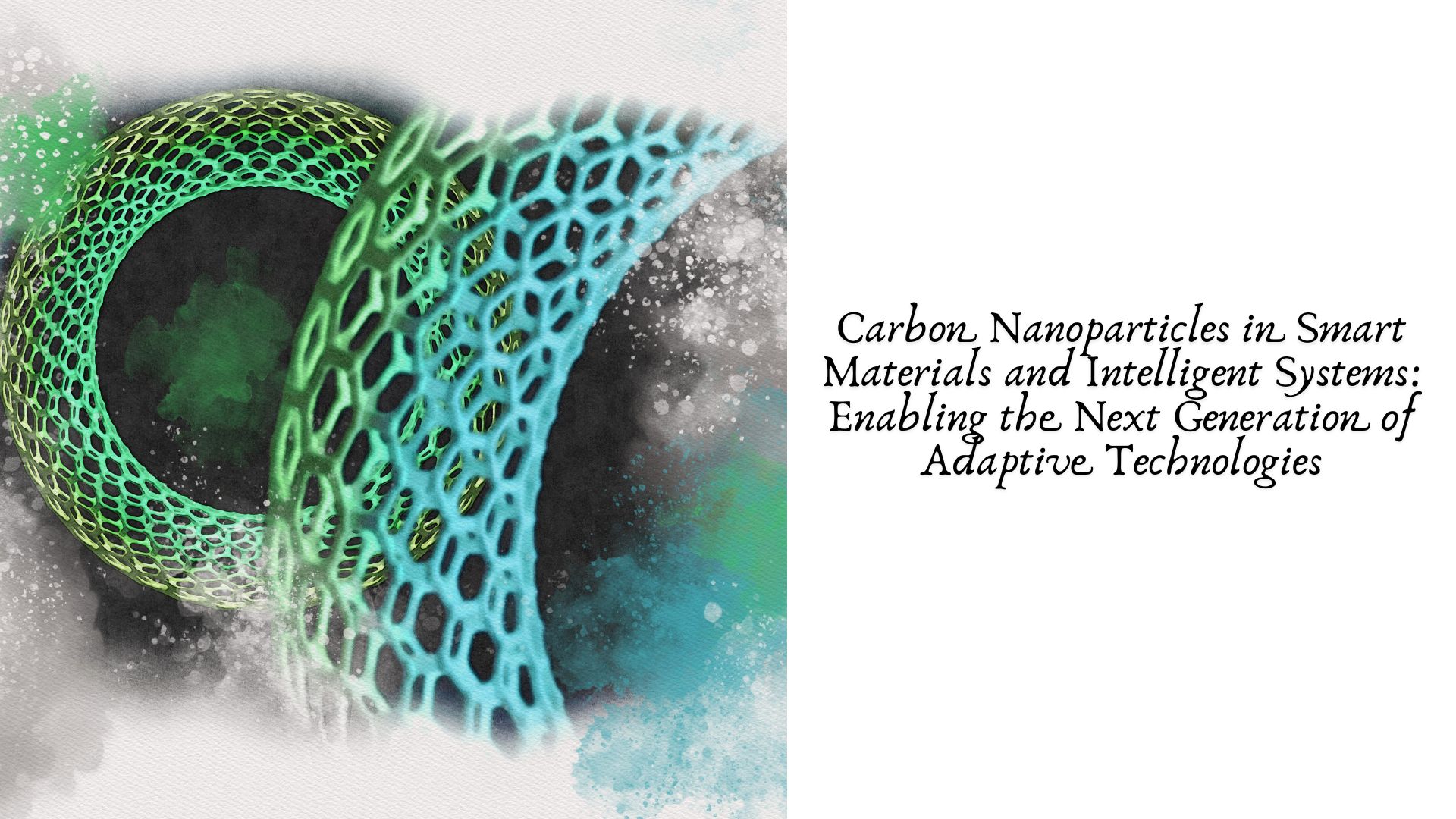
Smart materials and intelligent systems represent a transformative shift in how materials interact with their environment. Unlike conventional materials, smart materials can sense external stimuli—such as temperature, pressure, electric fields, light, or chemical changes—and respond in a controlled and often reversible manner. At the heart of many recent breakthroughs in this field are carbon nanoparticles (CNPs), a diverse family of nanoscale carbon-based materials that include carbon nanotubes (CNTs), graphene and graphene derivatives, carbon quantum dots (CQDs), nanodiamonds, and fullerenes.
Thanks to their exceptional electrical, mechanical, thermal, and chemical properties, carbon nanoparticles have become key enablers of intelligent behavior in materials and systems. This article explores how carbon nanoparticles are shaping smart materials and intelligent systems, the mechanisms behind their functionality, and the future potential of this rapidly evolving domain.
Understanding Carbon Nanoparticles
Carbon nanoparticles are nanoscale structures composed primarily of carbon atoms arranged in different configurations. Their properties depend strongly on their structure, size, and surface chemistry.
Key characteristics include:
- High electrical conductivity
- Large surface-area-to-volume ratio
- Excellent mechanical strength
- Chemical tunability through surface functionalization
- Thermal stability
These features make carbon nanoparticles ideal building blocks for materials that need to sense, process, and respond to information at the micro- or nanoscale.
Smart Materials and Intelligent Systems: An Overview
Smart materials are capable of:
- Sensing changes in their environment
- Processing the sensed information
- Actuating or responding appropriately
When integrated with control algorithms, electronics, or artificial intelligence, these materials become part of intelligent systems—systems that can learn, adapt, and optimize their behavior over time.
Examples include:
- Self-healing coatings
- Shape-memory composites
- Adaptive sensors and actuators
- Responsive biomedical implants
- Intelligent infrastructure materials
Carbon nanoparticles enhance all these functionalities by acting as nanoscale sensors, signal transducers, and functional reinforcements.
Role of Carbon Nanoparticles in Smart Materials
Electrical and Piezoresistive Sensing
Carbon nanoparticles, especially CNTs and graphene, exhibit strong piezoresistive behavior, meaning their electrical resistance changes under mechanical deformation.
Applications include:
- Structural health monitoring in buildings and bridges
- Wearable strain and motion sensors
- Flexible pressure sensors in robotics
Embedding carbon nanoparticles into polymers allows the material itself to function as a distributed sensor network.
Thermal Responsiveness
Carbon nanoparticles possess excellent thermal conductivity. When incorporated into smart composites, they enable:
- Rapid heat dissipation or retention
- Temperature-sensitive electrical switching
- Thermally adaptive surfaces
These properties are particularly valuable in aerospace components, electronics packaging, and energy-efficient building materials.
Self-Healing and Damage Detection
Smart materials enhanced with carbon nanoparticles can detect microcracks before catastrophic failure occurs. Changes in conductivity or optical signals serve as early warnings of damage.
In self-healing systems:
- Carbon nanoparticles help localize damage
- They assist in triggering healing reactions
- They restore electrical pathways after repair
This capability is critical for extending the lifespan of high-value structures and devices.
Optical and Photonic Responsiveness
Carbon quantum dots and graphene-based nanoparticles show tunable photoluminescence and strong light–matter interactions.
These properties enable:
- Light-responsive smart coatings
- Optical sensors and displays
- Intelligent photonic devices
In intelligent systems, optical signals often serve as fast, low-energy communication pathways.
Carbon Nanoparticles in Intelligent Systems
Smart Sensors and Sensor Networks
Carbon nanoparticle-based sensors are:
- Highly sensitive
- Miniaturized
- Capable of real-time data acquisition
They are widely used in intelligent systems for:
- Environmental monitoring
- Gas and chemical detection
- Biomedical diagnostics
Their ability to detect extremely small changes makes them ideal for autonomous decision-making systems.
Artificial Intelligence and Neuromorphic Systems
Carbon nanoparticles are increasingly explored in neuromorphic computing, which mimics the human brain’s neural architecture.
Key contributions include:
- Memristive behavior for synaptic emulation
- Low-power signal processing
- High-density integration
Graphene and CNT networks enable adaptive learning and pattern recognition at the hardware level, bridging materials science and artificial intelligence.
Soft Robotics and Adaptive Actuators
In soft robotics, materials must be flexible, lightweight, and responsive. Carbon nanoparticles enhance:
- Electrical actuation
- Sensing-feedback loops
- Energy efficiency
Smart polymer–carbon nanoparticle composites allow robots to sense touch, pressure, and deformation while responding intelligently.
Energy-Aware Intelligent Materials
Carbon nanoparticles also play a crucial role in energy-harvesting smart systems, such as:
- Piezoelectric–carbon nanocomposites
- Thermoelectric materials
- Smart supercapacitors and micro-batteries
These systems power themselves while monitoring and adapting to their surroundings.
Advantages of Carbon Nanoparticles in Smart Systems
- Multifunctionality: A single additive provides sensing, conductivity, and reinforcement
- Scalability: Suitable for large-area and flexible systems
- Customization: Surface functionalization tailors response behavior
- Compatibility: Easily integrated into polymers, ceramics, and metals
These advantages make carbon nanoparticles uniquely suited for next-generation intelligent materials.
Challenges and Limitations
Despite their promise, several challenges remain:
- Uniform dispersion in host matrices
- Long-term stability and reliability
- Cost-effective large-scale manufacturing
- Standardization and safety considerations
Addressing these issues is essential for widespread industrial adoption.
Future Outlook
The future of carbon nanoparticles in smart materials and intelligent systems is highly promising. Emerging trends include:
- AI-integrated self-learning materials
- Smart infrastructure with embedded sensing
- Autonomous biomedical implants
- Sustainable and recyclable smart composites
As nanotechnology, data science, and materials engineering converge, carbon nanoparticles will play a central role in creating materials that not only respond—but also think, learn, and evolve.
Conclusion
Carbon nanoparticles have moved far beyond being mere fillers or reinforcements. In smart materials and intelligent systems, they act as the functional core, enabling sensing, adaptability, intelligence, and resilience. From responsive infrastructure and wearable electronics to neuromorphic computing and soft robotics, carbon nanoparticles are redefining what materials can do.
As research advances and manufacturing challenges are overcome, carbon nanoparticle-enabled smart materials will become foundational elements of future intelligent technologies—shaping a world where materials are no longer passive, but active participants in our technological ecosystems.
Discover Modern Comfort: A Guide to Apartment Rent in Beirut
Beirut, the lively capital of Lebanon, is a city that blends deep-rooted history with a mo…



Discover Modern Comfort: A Guide to Apartment Rent in Beirut
Beirut, the lively capital of Lebanon, is a city that blends deep-rooted history with …