

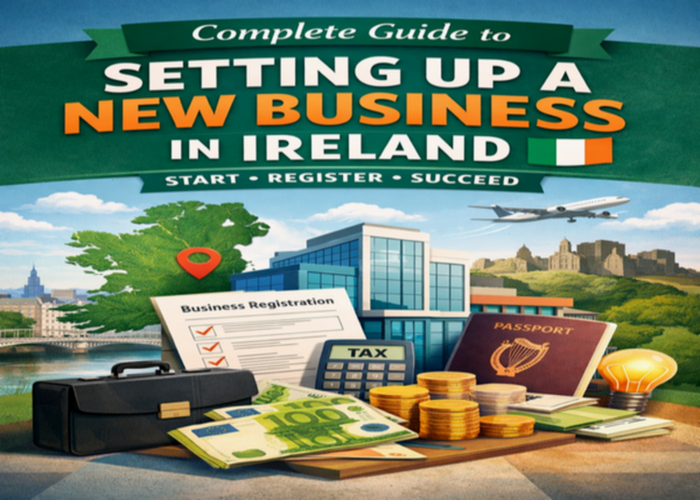
Setting up a business in Ireland is not about trends; it’s about opportunity. The country offers access to European markets, clear regulations, and a pro-business government framework.
If you’re exploring Ireland seriously or already convinced, this guide is for you. Unlike the usual recycled checklists, here we slow down, decode the system, and highlight what truly matters—strategy, compliance, costs, and common pitfalls. No hype. No shortcuts. Just practical insight from experience.
Let’s dive in.
Understanding the Irish Business Environment
1. Economic Overview of Ireland
Ireland has one of the most open and globally connected economies in Europe. Membership in the EU provides seamless access to the single market. Regulatory clarity and responsive government agencies make it accessible and predictable for businesses.
2. Key Industries and Market Opportunities
Tech and software development dominate, alongside fintech, life sciences, pharmaceuticals, medtech, and professional services. Opportunities also exist in consulting, logistics, creative services, and cross-border trade.
The trick is not chasing trends but understanding Ireland as a gateway to Europe, the UK, and beyond.
3. Business Culture and Commercial Practices
Irish business culture values clarity, credibility, and relationships. Meetings are friendly but direct. Formal contracts are standard, while trust is earned through transparency and consistency.
If you expect bureaucracy, Ireland feels refreshingly human—professional but approachable.
Choosing the Right Business Structure
1. Sole Trader – Quick and Simple Setup
Fast and minimal setup, suitable for freelancers and consultants. Profits are taxed as personal income, and you carry full liability.
2. Partnership – Sharing Risk and Expertise
Two or more partners share profits, responsibilities, and risks. Works best when roles are clearly defined. Personal liability applies.
3. Private Limited Company (LTD) – Protect Your Assets
Most founders prefer an LTD for growth. It separates personal and business liability, supports investment, and allows international operations. One director and one shareholder is sufficient.
4. Branch Office vs Subsidiary
A branch is simpler but exposes the parent company to Irish liabilities. A subsidiary is a separate legal entity and is often favored by banks and partners.
5. Factors to Consider
Liability exposure, tax treatment, funding plans, and operational complexity. What works today should also support growth in the future.
Legal and Registration Requirements
1. Registering a Business Name
Any business trading under a different name must register it. Distinctive names avoid rejections.
2. Company Registration Office (CRO) Process
Submit constitutional documents, director details, and a registered office address. Approved companies receive a registration number and legal status.
3. Director and Company Secretary Requirements
At least one director is required. A single director must have a separate company secretary. Non-residents can be directors with additional compliance.
4. Registered Office Address Requirements
A physical address in Ireland is mandatory. This is used for legal correspondence.
5. Timelines and Costs
Electronic filings take a few business days. Accuracy prevents delays. Professional services can simplify this.
Step-by-Step Registration Process
- Prepare constitutional documents, director and shareholder details, registered office address, and declarations.
- Submit electronically via the CRO portal. Accuracy is critical.
- Upon approval, incorporation is confirmed digitally.
Electronic filings are faster and more cost effective. Manual filings take longer and cost more. Preparation is key.
Tax Registration and Compliance
1. Corporate Tax Registration
Register with Revenue Commissioners after incorporation. Corporation tax applies to company profits.
2. VAT Registration
Depends on turnover thresholds and business activity. Voluntary registration is possible to reclaim VAT.
3. PAYE and Employer Obligations
If hiring, register as an employer to operate PAYE, manage income tax, and social insurance. Payroll must align with Revenue rules.
4. Irish Tax Deadlines
Corporation tax, VAT, payroll, and annual returns each have specific deadlines. Missing them results in penalties.
Opening a Business Bank Account
1. Required Documentation
Banks require incorporation documents, director IDs, proof of address, and business activity details.
2. Choosing Between Local and Digital Banks
Traditional banks offer stability but may require in-person verification. Digital banks onboard faster but with some limitations.
3. Non-Resident Directors
Enhanced due diligence can extend timelines. Clear documentation helps. Patience is essential.
Legal, Regulatory, and Compliance Obligations
- File annual returns and financial statements with the CRO.
- Directors must act in good faith, maintain records, and ensure solvency.
- Comply with GDPR and data protection if handling personal data.
- Certain industries require licenses or permits—plan early.
Hiring Employees
- Employment contracts are mandatory, outlining notice, leave, and termination.
- Minimum wage and working hours regulations apply.
- Employers contribute to social insurance covering pensions, sick leave, and statutory benefits.
- Remote and hybrid work is allowed but labor laws still apply. Policies should be documented clearly.
Costs of Setting Up and Running a Business
- Initial setup: Incorporation fees, professional services, and registered office arrangements.
- Ongoing operational expenses: Accounting, tax filings, banking, insurance, and office costs.
- Professional fees: Accountants, legal advisors, and compliance specialists are an investment that prevents costly mistakes.
Government Grants and Support
- Enterprise Ireland: Supports export-oriented businesses with funding, mentoring, and market access.
- Local Enterprise Office (LEO): Offers training, mentoring, and feasibility grants for small businesses.
- Startup grants: Competitive but supplement strong business fundamentals.
Common Mistakes to Avoid
- Choosing the wrong structure for long-term growth.
- Underestimating ongoing compliance obligations.
- Neglecting proactive tax and financial planning.
Learning from common pitfalls reduces risk and saves time.
How Professional Advisors Help
- Accountants and legal advisors translate rules into practical steps and flag risks early.
- Company formation services handle incorporation efficiently.
- Advisors provide ongoing support as the business scales, adapting structures and compliance processes.
Conclusion
Setting up a business in Ireland is about building a sustainable foundation. The country offers access, credibility, and structure, but expects professionalism in return.
Founders benefit from the right setup, advisors, and infrastructure. Whether launching a tech venture, consultancy, or European hub, Ireland provides a strong platform. Solutions like a virtual office in Dublin can help combine location flexibility with regulatory compliance.
Plan carefully. Prepare thoroughly. Treat setup not as a hurdle but as the foundation for lasting success.
FAQ’S
1. Why do so many international founders choose Ireland to start a business?
Ireland offers a rare mix of market access, regulatory clarity, and global credibility. Being part of the European Union allows businesses to trade freely across member states, while the country’s transparent legal and tax systems make long term planning easier. For international founders, Ireland often functions as a stable gateway into Europe rather than just a domestic market.
2. Is setting up a business in Ireland complicated for first-time founders?
The process itself is structured and logical, but it can feel complex if you are unfamiliar with local requirements. Incorporation, tax registration, banking, and compliance each sit with different authorities. Founders who approach setup step by step usually find the system efficient. Problems tend to arise when steps are rushed or compliance is treated as an afterthought.
3. How important is the choice of business structure in Ireland?
The business structure you choose shapes everything from taxation to personal liability and future growth options. Many founders initially focus on speed, but structure decisions should support where the business is headed in two or three years. In Ireland, restructuring later is possible, but it often involves additional cost and administrative work that could have been avoided early on.
4. What ongoing responsibilities should new Irish companies be prepared for?
Incorporation is only the starting point. Companies must file annual returns, meet tax deadlines, maintain proper records, and comply with company law and data protection rules. These obligations are predictable and manageable, but they are continuous. Businesses that build compliance into their operations from the beginning tend to operate with far less friction.
5. Can professional advisors really make a difference during business setup?
Yes, particularly for founders operating internationally or across multiple jurisdictions. Advisors help translate legal and tax requirements into practical actions, flag risks early, and prevent small errors from becoming costly delays. Over time, their value often extends beyond setup into strategic planning, compliance management, and sustainable growth.
Discover Modern Comfort: A Guide to Apartment Rent in Beirut
Beirut, the lively capital of Lebanon, is a city that blends deep-rooted history with a mo…



Discover Modern Comfort: A Guide to Apartment Rent in Beirut
Beirut, the lively capital of Lebanon, is a city that blends deep-rooted history with …