

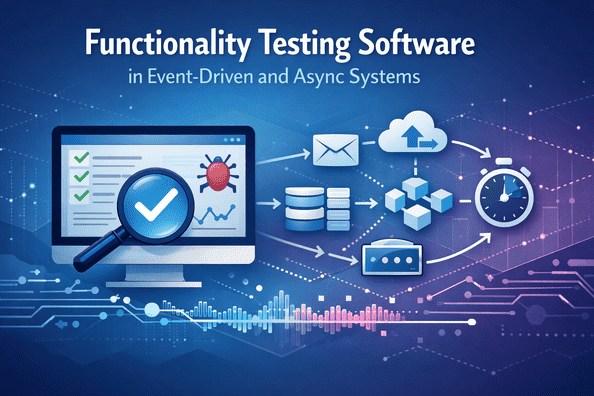
Event-driven and asynchronous systems have become the backbone of modern software architectures. Message queues, event streams, webhooks, and background workers allow applications to scale independently and respond to changes in real time. While this architectural style improves performance and resilience, it also makes testing significantly more complex.
In such environments, functionality testing software plays a crucial role in validating that systems behave correctly across loosely coupled components. Traditional testing approaches often fall short because there is no single, linear execution path to validate. Instead, teams must focus on outcomes, state changes, and interactions that occur over time.
Why Event-Driven Systems Are Harder to Test
In synchronous systems, a request produces an immediate response, making test assertions straightforward. Event-driven systems work differently. Actions are triggered indirectly, often across services and time boundaries.
Common challenges include:
-
Events processed asynchronously with no immediate feedback
-
Multiple consumers reacting to the same event
-
Out-of-order event delivery
-
Eventual consistency instead of immediate state updates
-
Hidden dependencies between producers and consumers
These characteristics make it difficult to verify system behavior using unit tests alone. This is where functionality testing software becomes essential.
What Functionality Testing Software Validates in Async Architectures
Functionality testing software focuses on validating externally observable behavior rather than internal implementation details. In event-driven systems, this means asserting outcomes instead of execution steps.
Examples include:
-
An order event eventually results in an invoice being generated
-
A failed payment triggers a retry workflow
-
A user action emits multiple downstream events across services
-
A delayed event still leads to a consistent system state
Rather than testing individual handlers in isolation, functionality testing software validates whether the system behaves correctly from a business perspective.
Testing Outcomes Instead of Execution Paths
One of the most important shifts in async systems is moving away from step-by-step assertions. Because events may be processed at different times or by different services, tests should focus on final states.
Effective functionality testing software enables teams to:
-
Assert database state changes after events are processed
-
Validate emitted events or notifications
-
Check side effects such as logs, metrics, or callbacks
-
Confirm idempotent behavior when events are retried
This outcome-based testing approach aligns naturally with the asynchronous nature of modern systems.
Handling Event Timing and Non-Determinism
Timing is one of the hardest problems in async testing. Events may be delayed, retried, or processed concurrently. Poorly designed tests often fail intermittently, leading to flakiness and mistrust.
Good functionality testing software helps manage this by:
-
Supporting polling or eventual assertions
-
Allowing configurable time windows for validation
-
Avoiding hard-coded sleeps in tests
-
Providing deterministic replay of event flows
These capabilities allow teams to test asynchronous behavior without making pipelines unstable.
Validating Cross-Service Interactions
In event-driven systems, business logic often spans multiple services. A single event may trigger a cascade of actions across the system.
Functionality testing software enables teams to validate:
-
Correct event payloads between producers and consumers
-
Compatibility across service versions
-
Proper handling of schema changes
-
Failure scenarios such as missing or malformed events
By testing these interactions at the functional level, teams gain confidence that independent deployments do not break system behavior.
Testing Failure and Retry Scenarios
Failures are expected in async systems. Messages may fail processing, consumers may go offline, and retries may occur automatically.
Functionality testing software is particularly valuable for validating:
-
Retry policies and backoff logic
-
Dead-letter queue handling
-
Idempotent processing of duplicate events
-
Recovery behavior after transient failures
These scenarios are difficult to validate manually and often overlooked until production incidents occur.
Preventing Silent Business Logic Failures
One of the biggest risks in event-driven architectures is silent failure. An event may be published successfully but never processed correctly downstream.
Functionality testing software helps detect these issues by validating end-to-end outcomes rather than individual components. If a downstream effect does not occur, the test fails, even if no service throws an error.
This approach surfaces issues such as:
-
Misconfigured consumers
-
Broken event subscriptions
-
Schema mismatches
-
Logic gaps introduced during refactoring
Integrating Functionality Testing Software Into CI Pipelines
Async systems often require longer validation windows, which can conflict with fast CI pipelines. To balance this, teams typically:
-
Run lightweight functional checks on every commit
-
Execute deeper async tests on pull request merges
-
Schedule full event-flow validation in nightly builds
Functionality testing software that supports selective execution and environment control fits well into this staged testing strategy.
Using Real Event Flows to Improve Test Accuracy
Synthetic test data often fails to capture the complexity of real-world event flows. Tests become outdated as systems evolve.
Some teams address this by generating functional tests from actual runtime behavior. Tools like Keploy allow teams to capture real API calls and event interactions, then replay them as tests. This makes functionality testing software more representative of production behavior, especially in asynchronous systems.
Best Practices for Testing Event-Driven Systems Functionally
To get the most value from functionality testing software in async architectures, teams should:
-
Focus on business outcomes, not internal steps
-
Avoid brittle timing assumptions
-
Test failure and retry paths explicitly
-
Validate contracts between event producers and consumers
-
Continuously update tests based on production learnings
These practices help ensure tests remain valuable as systems scale.
Conclusion
Event-driven and asynchronous systems demand a different approach to testing. Traditional methods that rely on synchronous execution and immediate responses are no longer sufficient.
Functionality testing software provides a practical way to validate behavior across time, services, and failure scenarios. By focusing on outcomes instead of execution order, teams can confidently test complex async systems without slowing development.
As architectures continue to move toward decoupled, event-driven designs, functionality testing software will remain a foundational tool for ensuring reliability and business correctness.
Discover Modern Comfort: A Guide to Apartment Rent in Beirut
Beirut, the lively capital of Lebanon, is a city that blends deep-rooted history with a mo…



Discover Modern Comfort: A Guide to Apartment Rent in Beirut
Beirut, the lively capital of Lebanon, is a city that blends deep-rooted history with …