

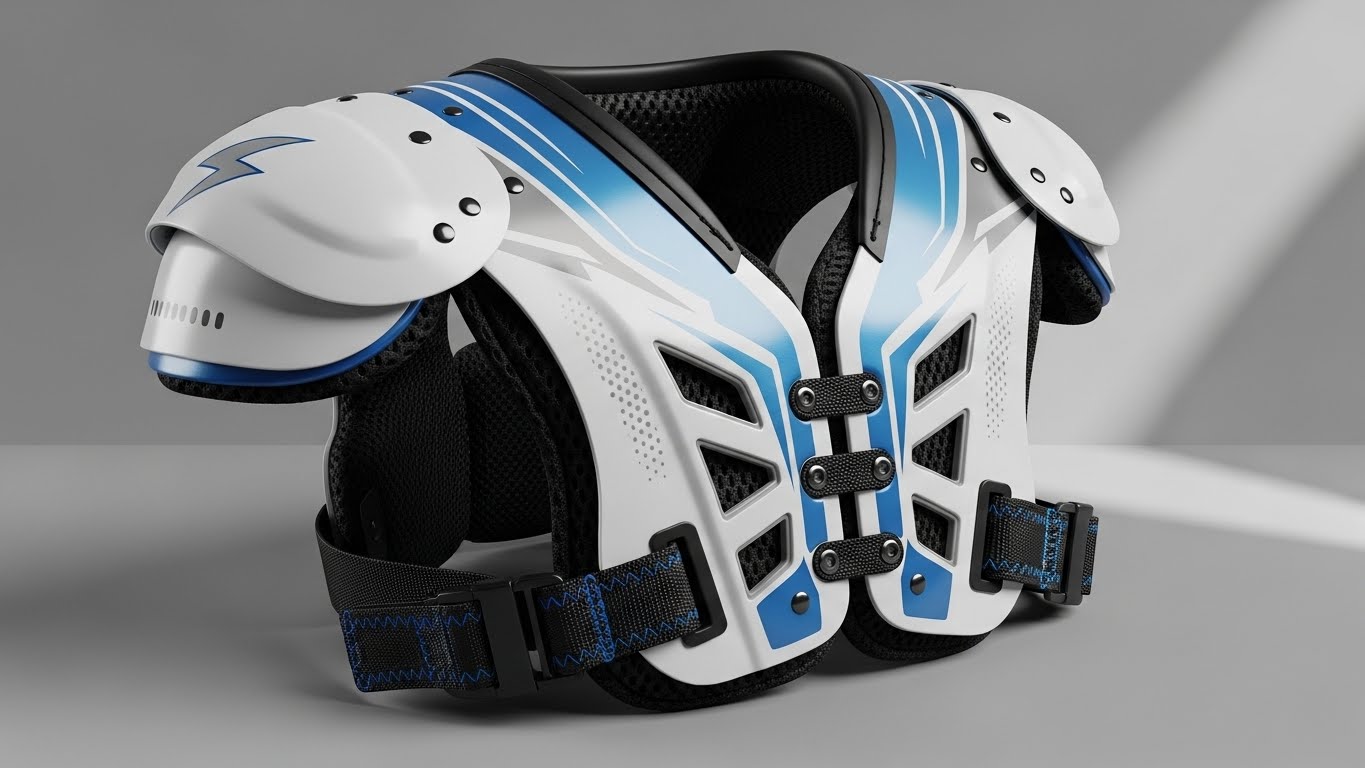
Designing protective equipment for youth athletes presents fundamentally different challenges than creating gear for physically mature players. The unique requirements of developing bodies, constantly changing proportions, and age-specific movement patterns demand thoughtful engineering approaches that prioritize both immediate safety and long-term athletic development. Modern Youth shoulder pads exemplify these design challenges, requiring manufacturers to balance protection, fit accommodation across growth phases, and biomechanical considerations specific to athletes whose neuromuscular systems are still maturing. Understanding how these factors shape equipment design reveals the sophisticated analysis underlying effective youth protective gear and highlights why simply scaling down adult equipment proves inadequate for young athletes’ needs.
The Unique Anatomy of Developing Athletes
Youth athletes’ skeletal and muscular structures differ fundamentally from adults in ways that directly impact shoulder pad design requirements. The most significant difference involves incomplete skeletal ossification—the process by which cartilage gradually transforms into bone throughout childhood and adolescence. Many bones that appear singular in adults exist as multiple separate ossification centers in youth, connected by cartilaginous growth plates that don’t fully fuse until the late teens or early twenties.
The clavicle, one of the primary structures shoulder pads must protect, doesn’t complete ossification until age 25 in many individuals, making it particularly vulnerable during youth sports participation. The acromion process—the bony prominence at the top of the shoulder blade—develops from a separate ossification center that doesn’t fuse until the late teens. These incomplete structures are more susceptible to fractures and growth plate injuries than mature bone, requiring youth shoulder pads to provide more comprehensive protection than might be necessary for adults.
The shoulder joint’s supporting musculature in youth athletes also differs significantly from mature athletes. Young players have less developed rotator cuff muscles, lower muscle mass surrounding the shoulder joint, and less robust connective tissue providing joint stability. Research from the American Orthopaedic Society for Sports Medicine indicates that shoulder instability issues are 2-3 times more common in youth athletes than adults when normalized for activity level and impact exposure, suggesting that immature muscular development leaves the joint more vulnerable.
These anatomical differences demand thatyouth football shoulder pads provide more coverage and support than adult equipment might require for equivalent protection levels. Pad designs must shield not just the bones themselves but also the vulnerable growth plate regions, incompletely ossified structures, and joints with insufficient muscular support. This comprehensive protection requirement fundamentally shapes design approaches for youth equipment.
Accommodating Rapid Growth Patterns
Perhaps the most challenging aspect of youth shoulder pads design involves accommodating the rapid, unpredictable growth youth athletes experience. During peak growth periods—typically ages 11-14 for girls and 13-16 for boys—young athletes can grow 3-4 inches in height and gain 15-25 pounds in a single year. This rapid change makes maintaining proper equipment fit extremely difficult.
Traditional rigid shoulder pad designs sized precisely for an athlete’s current dimensions become ill-fitting within months as growth occurs. Pads that fit properly in August may be uncomfortably tight by November, restricting movement and potentially causing equipment to press painfully into growing skeletal structures. Conversely, purchasing oversized equipment to accommodate anticipated growth results in poor initial fit that compromises protection and allows excessive equipment movement that interferes with athletic performance.
Modern youth football shoulder pads address this challenge through adjustable design features that accommodate substantial size changes without requiring complete equipment replacement. Extension systems in the shoulder cap area allow the pads to expand as shoulder width increases. Adjustable chest and back plates can be repositioned to accommodate torso lengthening. Elastic strap systems provide fit flexibility across a range of body dimensions.
These adjustability features typically allow youth football shoulder pads to remain effective through 2-3 inches of height growth and 15-20 pounds of weight change—roughly equivalent to one peak growth year. This extended usability provides both economic benefits for families and programs while ensuring young athletes consistently wear properly fitted equipment throughout their participation.
Movement Pattern Differences Between Youth and Adult Athletes
The biomechanics of athletic movement differ substantially between youth and mature athletes in ways that directly impact shoulder pad design priorities. Young athletes typically demonstrate less refined movement patterns, greater variability in technique execution, and different strength-to-weight ratios that influence how they generate and absorb forces during competition.
Neuromuscular coordination—the nervous system’s ability to efficiently activate muscles in coordinated patterns—continues developing throughout adolescence. Youth athletes demonstrate less consistent movement mechanics than adults, with greater variability from repetition to repetition. This inconsistency means youth players are more likely to experience awkward collisions and falls where body positioning doesn’t optimally distribute impact forces, placing greater demands on protective equipment to manage poorly aligned impacts.
The strength-to-body-weight ratio in youth athletes typically favors body weight—young players often lack the strength to control their body momentum as effectively as mature athletes with similar relative strength levels. This disparity results in less controlled collisions where youth players cannot brace effectively or adjust body position to minimize impact severity. Youth shoulder pads must account for these uncontrolled impact scenarios through more comprehensive coverage and robust protective designs.
Tackling technique among youth players typically lags behind older athletes, with young players more likely to lead with their shoulders rather than maintaining the head-up, wrap-tackle technique modern coaching emphasizes. This technique deficit increases the frequency and severity of direct shoulder impacts, requiring youth football shoulder pads to provide exceptional shoulder cap protection even as they encourage proper technique through design elements that don’t interfere with correct body positioning.
Weight Distribution and Fatigue Management
The relative weight of protective equipment impacts youth athletes more significantly than adults due to their smaller body sizes and less developed musculature. A shoulder pad that weighs 4 pounds represents approximately 3-4% of body weight for a 130-pound high school sophomore but 5-7% for a 70-pound youth player. This proportional difference means equipment weight that adults barely notice can substantially fatigue young athletes.
Youth shoulder pads design prioritizes weight minimization through advanced materials and efficient structural designs that provide necessary protection without unnecessary mass. Carbon fiber reinforcement, high-performance polymers, and multi-density foam systems allow contemporary youth equipment to weigh 30-40% less than comparable protection required using traditional materials and construction methods.
The weight distribution across the body also receives careful attention in youth designs. Equipment engineers position heavier structural elements—typically hard plastic shells and high-density foams—to balance symmetrically and minimize off-center loading that would create postural compensations. The goal is keeping young athletes’ natural center of gravity as close to unequipped position as possible, preserving movement efficiency and reducing fatigue.
Research examining youth athlete performance with various equipment weights demonstrates measurable impacts on endurance and movement quality. A study published in Pediatric Exercise Science found that youth football players wearing equipment exceeding 5% of body weight showed significant sprint speed degradation and increased perceived exertion compared to those wearing lighter gear, even when total practice duration and activity remained constant.
Shoulder Flexibility and Range of Motion Requirements
Youth athletes require greater shoulder mobility than adults for equivalent athletic tasks due to their developing strength and technique. Activities that mature athletes accomplish through strength and refined technique—like throwing, catching, and tackling—demand more extensive range of motion from youth players still developing these capabilities.
Youth shoulder pads must accommodate this enhanced mobility requirement without compromising protection. The challenge involves providing comprehensive coverage over vulnerable anatomical structures while allowing the extreme arm elevation, rotation, and extension youth athletic movements demand. Traditional bulky designs that restrict motion force young athletes to alter their natural movement patterns, potentially ingraining poor mechanics that persist even after players grow into less restrictive adult equipment.
Modern designs address this challenge through articulated shoulder cap designs that move with the shoulder’s natural rotation rather than restricting it. Low-profile construction minimizes equipment extending beyond the natural shoulder line that would interfere with arm movements. Strategic cutouts and flexibility zones in chest and back plates allow torso rotation and bending without resistance from rigid equipment components.
Testing protocols foryouth football shoulder pads specifically evaluate range of motion preservation, measuring how much equipment restricts shoulder flexion, extension, abduction, and rotation compared to unequipped baselines. Quality youth designs typically restrict movement by less than 10% across these planes—minimal enough that athletes adapt without significant technique changes while providing substantially better protection than the near-zero restriction completely unprotected athletes experience.
Cognitive Load Considerations
Youth athletes’ developing cognitive capabilities influence equipment design in subtle but important ways. Young players have less developed spatial awareness, reduced ability to process multiple simultaneous information sources, and less automatic execution of athletic skills—all factors requiring greater cognitive attention than mature athletes devote to equivalent tasks.
Bulky or improperly fitted youth shoulder pads create awareness burdens that consume cognitive resources young athletes need for game execution. Equipment that shifts during play forces constant attention to pad positioning. Gear that restricts vision or peripheral awareness requires cognitive energy to compensate for reduced sensory input. Designs that feel uncomfortable create distraction that interferes with skill execution and tactical decision-making.
Modern youth football shoulder pads minimize these cognitive burdens through designs that players quickly forget they’re wearing. Proper fit that prevents shifting eliminates constant repositioning attention. Low-profile shoulder caps preserve peripheral vision and neck mobility that young players need for field awareness. Comfortable padding and strategic ventilation prevent the physical discomfort that would create mental distraction during competition.
Position-Specific Considerations for Youth Players
The position-specific equipment variations common in adult football also apply to youth levels, though the distinctions may be less pronounced given youth football’s generally lower impact forces and less specialized positional roles. Nevertheless, youth shoulder pads increasingly offer position-appropriate designs recognizing that even young players benefit from equipment optimized for their specific responsibilities.
Youth lineman shoulder pads prioritize protection over mobility, featuring larger shoulder caps, more extensive chest and back coverage, and generally more robust construction appropriate for the constant contact these positions experience. However, even lineman-specific youth designs typically weigh less and restrict movement less than comparable adult equipment, recognizing that youth linemen still need mobility that mature players with greater strength and refined technique can sacrifice for protection.
Youth skill position shoulder pads emphasize lightweight construction and maximum mobility, using low-profile designs that allow the arm movements throwing, catching, and ball carrying demand. These designs still provide comprehensive protection appropriate for youth anatomy’s vulnerability but achieve it through advanced materials and efficient structural engineering rather than bulk.
Growth Prediction and Sizing Guidance
Effective youth shoulder pads fitting requires some prediction of anticipated growth to balance immediate proper fit with reasonable longevity. Equipment managers, coaches, and parents need guidance on selecting sizes that protect adequately in the present while accommodating expected development.
Quality manufacturers provide sizing tools incorporating not just current measurements but also age, growth history, and parental heights—factors that help predict near-term growth trajectories. These tools might recommend sizing at the smaller end of appropriate range for athletes with slowing growth velocity (typically older adolescents past peak growth spurts) while suggesting slightly larger sizes for younger athletes likely to experience rapid development.
However, this future-oriented sizing must be balanced carefully against the immediate fit requirements protective equipment demands. Shoulder pads that are too large leave gaps between equipment and body that compromise protection, allow excessive equipment movement that interferes with performance, and may actually increase injury risk despite providing protection in theory. The sizing guidance must find the narrow window where current fit is adequate while allowing reasonable accommodation of anticipated growth.
Safety Standard Compliance Across Size Ranges
Youth shoulder pads must meet the same NOCSAE (National Operating Committee on Standards for Athletic Equipment) certification standards that adult equipment does, ensuring adequate protection regardless of size. This requirement creates interesting engineering challenges since the testing protocols use standardized impact scenarios that don’t necessarily scale linearly across equipment sizes.
Smaller youth football shoulder pads have less surface area to distribute impact forces, potentially creating higher peak pressures unless foam densities and shell constructions are carefully optimized. The padding thickness in youth equipment often matches or exceeds adult equipment proportionally, providing equivalent energy absorption despite smaller overall dimensions.
The certification testing also validates that youth football shoulder pads maintain protective integrity across their intended adjustability ranges—equipment must protect adequately at both the minimum and maximum extension positions adjustable features provide. This ensures that pads don’t just fit across a range of sizes but actually protect equivalently regardless of adjustment position.
Conclusion
The design of youth shoulder pads represents sophisticated engineering that accounts for developing anatomy, rapid growth patterns, immature movement mechanics, and the unique biomechanical and cognitive demands youth athletes face. Rather than simply creating smaller versions of adult equipment, effective youth designs address the specific vulnerabilities incomplete skeletal ossification creates, accommodate the dramatic size changes peak growth periods produce, and provide protection without the weight and bulk that would overwhelm young athletes’ less developed musculature.
Understanding these design considerations reveals why youth-specific equipment development requires dedicated research and engineering rather than simple scaling approaches. As our knowledge of youth athlete development continues expanding and material science provides new opportunities for lightweight, protective designs, youth football shoulder pads will continue evolving to better serve young athletes’ needs. The goal remains constant—keeping young players safe while preserving the mobility and comfort that allows them to develop skills, enjoy competition, and build the foundation for lifelong athletic participation and physical activity.


Discover Modern Comfort: A Guide to Apartment Rent in Beirut
Beirut, the lively capital of Lebanon, is a city that blends deep-rooted history with a mo…



Discover Modern Comfort: A Guide to Apartment Rent in Beirut
Beirut, the lively capital of Lebanon, is a city that blends deep-rooted history with …