

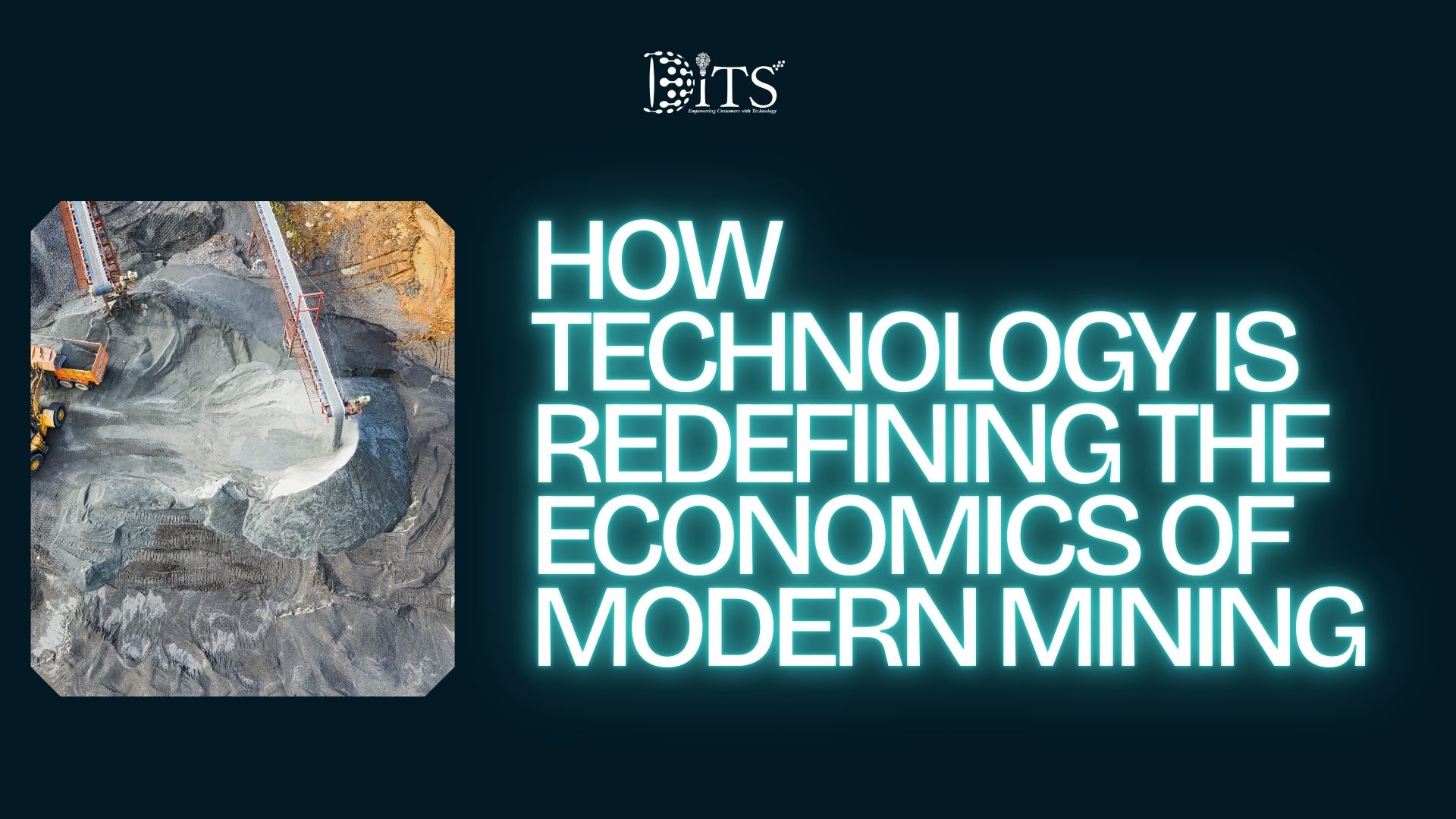
For much of its history, the mining industry operated on a straightforward economic equation: larger reserves, heavier machinery, and higher production volumes translated into profitability. That equation no longer holds.
Today’s mining economics are shaped by rising operational costs, volatile commodity prices, stricter environmental regulations, and mounting pressure to improve safety and efficiency. In this new reality, technology has emerged as the most powerful lever for protecting margins and sustaining long-term competitiveness.
Mining leaders are no longer asking whether to invest in digital transformation—they are asking how fast they can deploy it to reshape their cost structures and decision-making models.
From Capital-Heavy Operations to Intelligence-Driven Enterprises
Modern mining remains capital-intensive, but technology is shifting where value is created. Instead of relying solely on physical assets, leading mining organizations are investing in intelligence—data, automation, and advanced analytics.
Digital platforms now enable:
-
Real-time visibility into operations
-
Predictive insights instead of reactive responses
-
Optimization of resources across the entire value chain
This transition is fundamentally changing how mining companies think about productivity, risk, and return on investment.
Cost Reduction Through Predictive and Preventive Operations
One of the most immediate economic impacts of technology is cost control. Equipment downtime, inefficient maintenance, and unplanned disruptions can erode margins quickly.
Advanced systems allow mining companies to:
-
Predict equipment failures before they occur
-
Schedule maintenance strategically rather than reactively
-
Reduce spare part waste and emergency repairs
These capabilities convert unpredictable expenses into controlled operational costs, improving financial stability across cycles.
Data-Driven Decisions Replace Assumptions and Gut Feel
Mining operations generate enormous volumes of data, but traditional systems struggle to turn that data into insight. Modern digital platforms integrate operational, financial, and environmental data into unified decision frameworks.
Executives gain:
-
Clear performance benchmarks across sites
-
Early warnings for operational or financial risk
-
The ability to simulate scenarios before committing capital
This shift from assumption-based planning to data-driven execution has a direct and measurable impact on profitability.
Workforce Productivity Without Proportional Cost Increases
Labor remains one of the most complex cost components in mining. Technology is enabling mining companies to improve workforce productivity without increasing headcount.
Digital workforce systems help organizations:
-
Optimize shift planning and skill allocation
-
Reduce overtime and compliance-related penalties
-
Improve safety outcomes while maintaining productivity
The result is a leaner, more resilient workforce model aligned with modern operational demands.
Optimizing Energy, Fuel, and Resource Consumption
Energy and fuel costs represent a significant portion of mining operating expenses. Intelligent monitoring and analytics platforms identify inefficiencies that were previously invisible.
By analyzing consumption patterns, mining companies can:
-
Reduce idle fuel usage
-
Improve haulage efficiency
-
Lower emissions while cutting costs
These efficiencies not only strengthen margins but also support ESG and sustainability objectives.
Scaling Operations Without Scaling Complexity
Growth traditionally introduced disproportionate complexity in mining—new sites meant new systems, teams, and risks. Technology is changing that dynamic.
Scalable digital architectures allow mining organizations to:
-
Standardize processes across sites
-
Maintain governance while enabling local flexibility
-
Expand operations without rebuilding core systems
This scalability is redefining how mining companies approach expansion and capital planning.
Why Custom Technology Is Driving Economic Advantage
Generic platforms often struggle to accommodate the operational realities of mining. Forward-thinking organizations are turning to tailored mining software solutions that align precisely with their workflows, equipment, and regulatory environments.
When designed and implemented by the right software development company, these systems become strategic assets—continuously evolving with the business and delivering long-term economic value rather than short-term functionality.
Conclusion: Technology as the New Economic Engine of Mining
The economics of modern mining are no longer defined solely by what is extracted from the ground, but by how intelligently operations are run. Technology is enabling mining companies to control costs, reduce risk, and make better capital decisions in an increasingly complex global environment.
Mining leaders who invest in digital capabilities today are building operations that are more efficient, resilient, and competitive tomorrow. In an industry where margins are tight and stakes are high, technology has become the most reliable driver of sustainable economic performance.




Discover Modern Comfort: A Guide to Apartment Rent in Beirut
Beirut, the lively capital of Lebanon, is a city that blends deep-rooted history with a mo…



Discover Modern Comfort: A Guide to Apartment Rent in Beirut
Beirut, the lively capital of Lebanon, is a city that blends deep-rooted history with …