

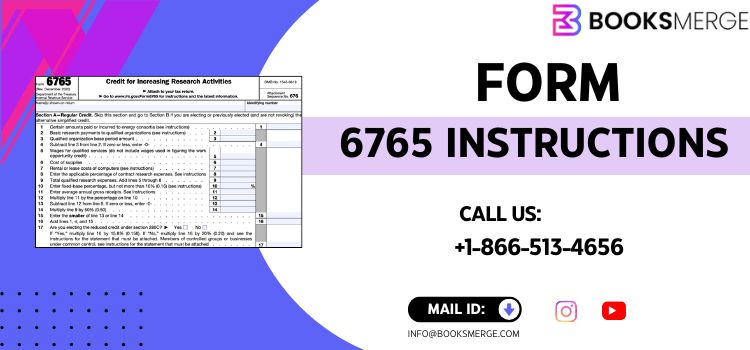
Form 6765 Instructions help businesses claim the federal R&D tax credit, report qualified research expenses, and choose between credit calculation methods while staying compliant with IRS rules.
Learning how to crunch IRS forms can feel like decoding a secret language. But if your business engages in research, Form 6765 Instructions will unlock valuable R&D tax credits. With the 2025 updates from the IRS and trusted insights from BooksMerge, this article walks you through everything you need to know, step by clear step.
Table of Contents
- What Is Form 6765?
- What Is Form 6765 Used For?
- Key Concepts You Must Know
- Qualified Research Expenses (QREs)
- Alternative Simplified Credit (ASC)
- How to Complete Form 6765 (Item by Item)
- 2025 Updates You Should Know
- Who Qualifies for R&D Tax Credit?
- How to Calculate ASC vs Regular Method
- What Documents Are Required?
- Can Startups Use Payroll Offset?
- Common Mistakes to Avoid
- Filing Tips and Best Practices
- Conclusion
- FAQ
1. What Is Form 6765?
Form 6765, officially called Credit for Increasing Research Activities, lets eligible businesses calculate and claim the federal research and development (R&D) tax credit. It’s not just about innovation bragging rights — this form directly reduces tax liability if you qualify. The IRS updated the Form 6765 Instructions for the 2025 tax year, and understanding them can ensure you get the full benefit your investment deserves.
2. What Is Form 6765 Used For?
You use Form 6765 to:
- Calculate the R&D tax credit for qualified research activities.
- Elect a reduced credit under section 280C if it makes sense for your tax strategy.
- Elect the payroll tax credit instead of a traditional income tax credit, if eligible.
- Report credit amounts directly if you’re a partnership or S corporation.
If you’re an owner of a business that invests in research, this form turns your efforts into tax savings.
3. Key Concepts You Must Know
Before filling out the form, you’ll want to understand a few IRS terms that play big roles.
Qualified Research Expenses (QREs)
Qualified Research Expenses are costs that qualify for the R&D credit. These include wages, supplies, and contract research tied to projects that meet the IRS’s definition of research. Your business must use experimentation and technical uncertainty to improve or develop new products or processes.
Alternative Simplified Credit (ASC)
The Alternative Simplified Credit (ASC) is an optional method for calculating your research credit. It’s often simpler than the regular method, reducing the burden of complex historical calculations. Many companies choose it when they want a more predictable outcome.
4. How to Complete Form 6765 (Item by Item)
Here’s the core of the irs form 6765 instructions broken down into clear steps so you can confidently walk through the process.
Item A – Section 280C Election
At the top of the form, decide whether to elect the reduced credit under section 280C. This election affects how much credit you claim, and once you make it, you cannot change it for that tax year.
Section A – Regular Credit
This section walks you through calculating the regular credit using qualified research costs over a base period. You’ll list wage expenses, supply costs, and other qualifying items.
Section B – Alternative Simplified Credit (ASC)
If you elect the ASC, complete this section instead of Section A. ASC uses simpler math based on three prior years of QREs.
Section F – Qualified Research Expenses Summary
Here you summarize your total QREs and prepare the numbers that feed into the credit calculation.
Section D – Payroll Tax Credit Election
If you’re a qualified small business, you might choose to use your R&D credit toward payroll taxes (social security tax). There’s a $500,000 annual limit, and you must attach Form 8974 to your payroll return.
5. 2025 Updates You Should Know
The form 6765 instructions 2025 include some notable changes:
- New Section E – Other Information requires details if you reported QREs.
- New Section F – Qualified Research Expenses Summary helps organize totals.
- Section G – Business Component Info will soon be standard for most filers.
These changes help the IRS better understand your reporting and make compliance smoother.
Quick Tip: Learn how to fill out a 1040 form step by step to report income, claim deductions, and ensure accurate federal tax filing with ease.
6. Who Qualifies for R&D Tax Credit?
You must show that activities qualify as R&D under IRS rules:
- They involve experimentation.
- They aim for new or improved functionality, performance, quality, or reliability.
- They rely on science, engineering, or technology to solve uncertainty.
This doesn’t mean life science only. Software innovation, engineering improvements, biologics, and manufacturing process optimization can all count.
7. How to Calculate ASC vs Regular Method
When preparing your tax return, you have two ways to calculate your credit:
- Regular Method: Ties your credit to a historical base period and current expenses.
- ASC: Uses a simplified formula, often reducing complexity without losing much benefit.
- Most mid‑sized businesses find the ASC easier if they don’t have messy historic records. A tax professional can compare both for your exact math.
8. What Documents Are Required?
Before you start filling out the form, gather:
- Payroll records showing employees involved in eligible research.
- Receipts for supplies and contract research payments.
- Accounting details tracking research costs over multiple years.
In case of audit, IRS wants to see that you actually did the work and documented it. Good records make R&D credits far less stressful and far more defensible. For broader context on financial documentation and business readiness, see our study on small business financial literacy stats.
9. Can Startups Use Payroll Offset?
Yes! Qualifying small startups with low or no income tax liability can elect to use their R&D credit to reduce payroll tax instead. This option lets early‑stage companies see real cash savings earlier — up to $500,000 per year.
That practical tax strategy can free up funds for growth, hiring, or product development.
10. Common Mistakes to Avoid
Even seasoned business owners stumble on these:
- Forgetting to elect ASC or 280C at the right time.
- Missing supporting documentation for QREs.
- Misclassifying wages or expenditures.
- Failing to attach Form 8974 when electing payroll credit.
Careful review before filing avoids surprises later.
11. Filing Tips and Best Practices
Here’s what many successful filers do:
- Start early and gather costs throughout the year.
- Work with a tax pro familiar with R&D credits.
- Compare ASC vs Regular results before choosing.
- Attach all required schedules correctly and keep backup documentation.
If you want expert help at any point, BooksMerge can guide you through the entire process and help you maximize your R&D credit while staying compliant. Call +1‑866‑513‑4656 for personalized assistance and guidance tailored to your business.
Conclusion
The Instructions for Form 6765 are not optional reading. They’re the roadmap for unlocking a valuable federal tax benefit. Understanding who qualifies, how to calculate qualified expenses, and how to choose between methods gives your business confidence and real financial advantage.
Whether you’re a startup or an established innovator, the R&D tax credit can be a powerful financial tool — and with expert help, it’s far easier to claim than you might think.
FAQ
What is Form 6765 used for?
Form 6765 figures and claims the federal R&D tax credit and allows elections for reduced or payroll tax credits.
Who qualifies for R&D tax credit?
Businesses engaging in qualified research that solves technical uncertainty and aims to improve products or processes.
What are QREs?
Qualified Research Expenses include wages, supplies, and research contracts tied to R&D activities.
How to calculate ASC vs regular method?
ASC simplifies credit calculation using recent years’ QREs. Regular method uses a base period formula requiring more historical data.
What documents are required?
Payroll records, detailed expense logs, and supporting receipts for all qualified research activities.
Can startups use payroll offset?
Yes. Qualified small businesses can elect to use R&D credit against payroll taxes up to $500,000.
What changed in 2025?
IRS added new reporting sections (E, F, G) and clarified requirements to capture research data more efficiently.
Read Also: Form 6765 Instructions






Discover Modern Comfort: A Guide to Apartment Rent in Beirut
Beirut, the lively capital of Lebanon, is a city that blends deep-rooted history with a mo…



Discover Modern Comfort: A Guide to Apartment Rent in Beirut
Beirut, the lively capital of Lebanon, is a city that blends deep-rooted history with …