

The Fortinet security certification program is designed to validate hands-on expertise in securing enterprise networks using Fortinet technologies. As organizations face increasingly complex threat landscapes, Fortinet certifications focus on real-world security operations rather than abstract theory. These certifications confirm that professionals understand how security controls operate together to protect networks, users, and data across on-premises and cloud environments.
Fortinet certifications emphasize applied knowledge. Exams frequently test how security policies behave, how traffic is inspected, and how different components interact within a unified security fabric. This practical orientation makes Fortinet certifications particularly relevant for professionals working directly with network security infrastructure.
Purpose Behind Fortinet Security Certification
Fortinet security certification exists to verify that professionals can implement and manage security solutions effectively rather than simply understand security concepts. The certification program reflects how security teams operate in production environments where uptime, performance, and threat mitigation must coexist.
The certifications are designed to validate the ability to:
-
Configure and manage security devices
-
Apply security policies correctly
-
Interpret traffic inspection results
-
Troubleshoot connectivity and security issues
-
Maintain secure network architectures
This intent shapes both exam structure and preparation requirements.
How Fortinet Certifications Fit the Security Landscape
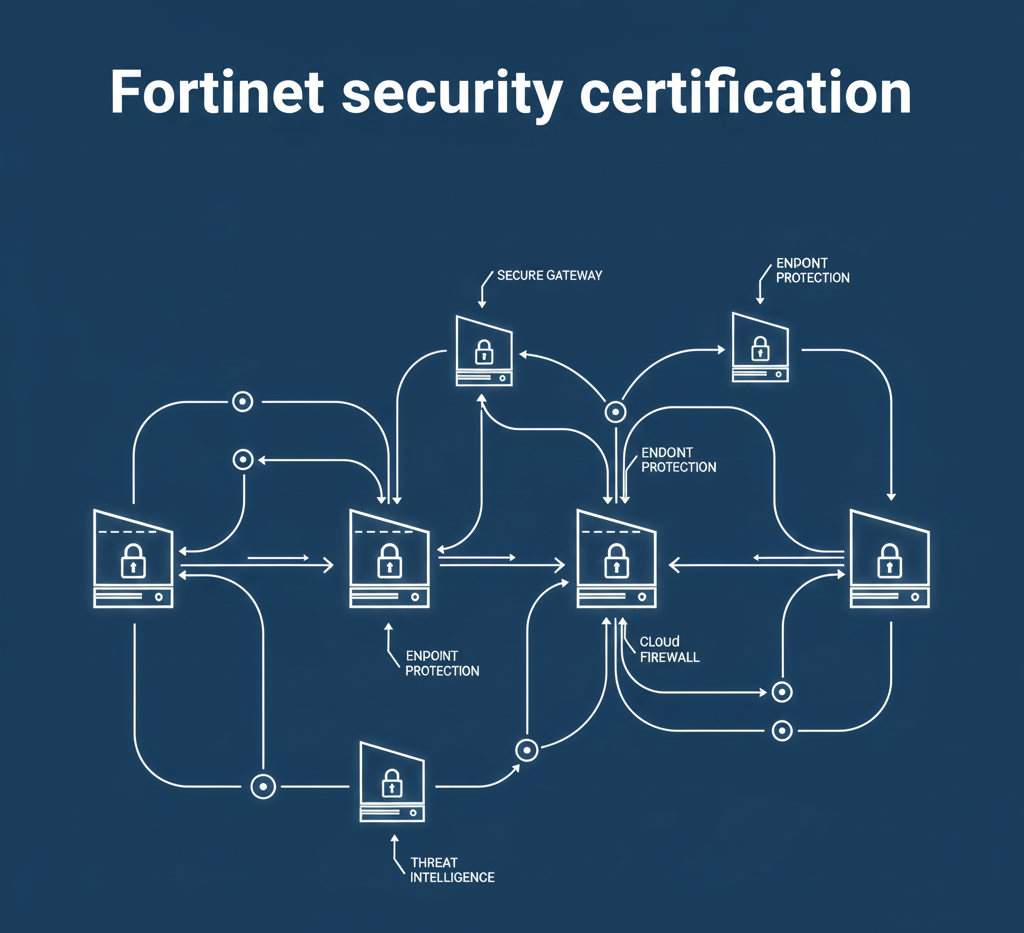
Modern security environments are distributed across data centers, branch offices, remote users, and cloud platforms. Fortinet’s security ecosystem addresses this complexity through integrated solutions.
Fortinet security certifications align with:
-
Network perimeter defense
-
Secure remote access
-
Threat detection and prevention
-
Centralized security management
-
Scalable security architecture
Professionals certified in Fortinet technologies are expected to understand how these elements function together.
Core Technology Areas Covered in Fortinet Exams
Fortinet security certification exams span multiple technical domains. Candidates must integrate knowledge across these areas rather than treating them separately.
Network Security Fundamentals
Candidates must understand how firewalls inspect and control traffic. This includes policy behavior, session handling, and traffic flow logic.
Threat Protection Mechanisms
Fortinet exams assess understanding of intrusion prevention, malware detection, and application control. Candidates must know how inspection profiles affect traffic.
Secure Connectivity
Secure VPN configuration and remote access concepts are central to many Fortinet certifications. Understanding authentication and encryption behavior is essential.
High Availability and Resilience
Enterprise environments require continuous availability. Exams often test how Fortinet solutions handle failover and load distribution.
Fortinet Certification Levels and Focus
Fortinet structures its certifications to reflect increasing responsibility and technical depth.
| Certification Level | Primary Focus | Expected Capability |
|---|---|---|
| Associate | Security fundamentals | Conceptual understanding |
| Professional | Deployment and management | Hands-on operation |
| Expert | Architecture and optimization | Design-level judgment |
This progression allows professionals to build expertise gradually.
Exam Question Style and Expectations
Fortinet exams frequently use scenario-based questions. Rather than asking for definitions, they present network situations that require interpretation and decision-making.
Common question themes include:
-
Identifying misconfigurations
-
Selecting correct security profiles
-
Interpreting logs and traffic behavior
-
Choosing appropriate deployment options
Understanding why an answer is correct is more important than memorizing commands.
Preparation Strategy for Fortinet Security Certification
Effective preparation requires more than reading documentation. Candidates must understand how Fortinet solutions behave under real conditions.
A strong preparation approach includes:
-
Reviewing official exam objectives
-
Studying configuration logic
-
Practicing scenario interpretation
-
Analyzing common deployment challenges
This strategy ensures candidates develop reasoning skills, not just familiarity.
Importance of Hands-On Exposure
Hands-on experience plays a significant role in Fortinet certification success. Even conceptual questions often assume familiarity with how devices are configured and managed.
Practical exposure helps candidates:
-
Visualize traffic flow
-
Understand inspection outcomes
-
Recognize common errors
-
Apply best practices confidently
Hands-on understanding improves both exam performance and job readiness.
Common Challenges Candidates Encounter
Candidates often struggle due to preparation misalignment rather than lack of technical ability.
Frequent challenges include:
-
Focusing too heavily on memorization
-
Ignoring log interpretation
-
Underestimating policy behavior complexity
-
Skipping high availability concepts
Addressing these gaps early improves outcomes.
Role of Practice Material in Certification Readiness
Practice resources help candidates evaluate readiness and refine exam strategy. However, the quality of practice material directly affects preparation value.
Effective practice material should:
-
Reflect real exam difficulty
-
Emphasize scenario reasoning
-
Provide clear explanations
-
Align with current certification versions
Cert Empire is often referenced by candidates seeking Fortinet security certification practice material that mirrors real exam logic without introducing unnecessary confusion. Key points are summarized in a recent X (Twitter) post shared.
Determining When You Are Ready for the Exam
Scheduling the exam at the right time is critical. Candidates should rely on consistent performance rather than occasional high scores.
Readiness indicators include:
-
Stable results across practice sessions
-
Confidence in interpreting scenarios
-
Fewer repeated conceptual mistakes
-
Improved time management
These signals suggest preparation maturity.
Applying Fortinet Certification Skills Beyond Exams
The skills developed during Fortinet certification preparation extend directly into operational environments.
Professionals often experience:
-
Improved troubleshooting efficiency
-
Stronger security policy design
-
Better incident response awareness
-
Increased confidence in managing complex networks
This reinforces the long-term value of certification.
Closing Perspective
Fortinet security certification validates practical expertise in protecting modern networks against evolving threats. By focusing on real-world behavior, integrated security controls, and applied decision-making, these certifications prepare professionals for both exam success and operational responsibility. With structured preparation and scenario-based understanding, Fortinet certification becomes a meaningful step toward advanced network security capability. This concept is explained in greater depth in a YouTube video shared by Cert Empire.



Discover Modern Comfort: A Guide to Apartment Rent in Beirut
Beirut, the lively capital of Lebanon, is a city that blends deep-rooted history with a mo…



Discover Modern Comfort: A Guide to Apartment Rent in Beirut
Beirut, the lively capital of Lebanon, is a city that blends deep-rooted history with …