

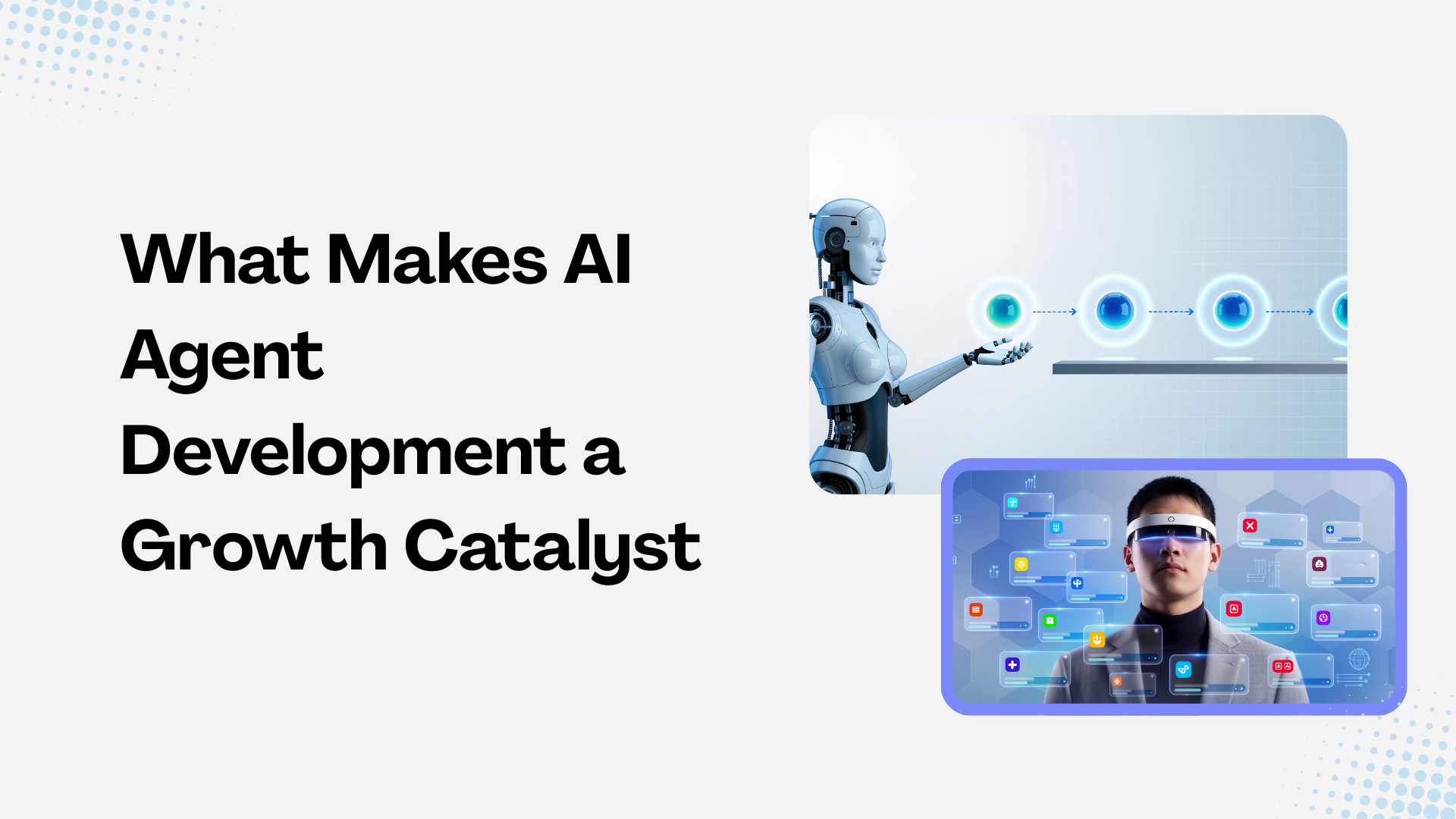
Growth used to follow a familiar script. Add more people. Expand into new markets. Invest in bigger systems. Over time, that formula has become harder to sustain. Costs rise faster than returns. Complexity compounds. Decision making slows just when speed matters most.
AI agent development is emerging as a different kind of growth lever. Not one based on scale through expansion, but scale through intelligence. Businesses are discovering that growth today depends less on doing more and more on doing things smarter.
This is why AI agents are increasingly viewed not as technical upgrades, but as catalysts that unlock new phases of business growth.
Growth Has Become a Problem of Complexity
Modern organizations are not short on ambition. They are short on clarity.
As businesses grow, they accumulate systems, data, processes, and teams. Each addition solves a problem, but together they create friction. Information is fragmented. Decisions require coordination across functions. Opportunities are missed because signals arrive too late or are drowned out by noise.
Traditional software manages data well, but it does not manage complexity well. It records what happened. It rarely helps decide what should happen next.
AI agent development directly addresses this gap. Agents are designed to operate inside complexity, not outside it.
Intelligence Scales Better Than Headcount
One of the most compelling reasons AI agents drive growth is their non-linear scalability.
Hiring scales linearly. More volume requires more people. More oversight requires more management. Eventually, growth slows under its own weight.
AI agents scale differently. Once deployed, they monitor continuously, evaluate conditions consistently, and act without fatigue. As volume increases, they do not require proportional increases in effort.
This allows businesses to grow revenue, customers, and operations without matching increases in overhead.
Growth becomes sustainable instead of fragile.
From Insight Lag to Real-Time Advantage
Many organizations have access to data but lack timely insight. Reports arrive after decisions should have been made. Dashboards require interpretation. Alerts overwhelm teams without guiding action.
AI agents compress the distance between signal and response.
They analyze data as it flows. They surface patterns early. They act or recommend actions in context.
This real-time intelligence creates competitive advantage. Opportunities are captured faster. Risks are mitigated earlier. Momentum builds.
Growth accelerates when decisions keep pace with reality.
Unlocking Growth Hidden Inside Existing Systems
Businesses often underestimate how much value is trapped inside their current systems. Data sits unused. Processes operate below potential. Teams work around limitations instead of through them.
AI agent development unlocks this latent value.
Agents connect systems that were previously siloed. They interpret data that was previously ignored. They optimize workflows that were previously rigid.
Instead of replacing infrastructure, agents amplify it.
Growth does not always require new platforms. Sometimes it requires making existing ones smarter.
Customer Experience as a Growth Multiplier
Sustainable growth depends on retention as much as acquisition. Customer experience plays a central role.
AI agents improve experience by making interactions more responsive and personalized. They anticipate needs. They resolve issues faster. They adapt responses based on context and history.
Customers feel understood rather than processed.
This builds trust and loyalty. Over time, it reduces churn and increases lifetime value.
Growth driven by experience is more durable than growth driven by marketing spend.
Faster Experimentation Without Operational Risk
Growth often requires experimentation. New pricing models. New workflows. New markets.
Traditional experimentation carries operational risk. Changes affect systems broadly. Rollbacks are costly.
AI agents enable controlled experimentation. Their behavior can be adjusted, observed, and refined without disrupting core operations. They operate within constraints and escalate when uncertainty rises.
This allows businesses to test ideas faster and learn safely.
Growth thrives in environments where learning is cheap and failure is contained.
Reducing Friction Across the Organization
Internal friction slows growth in subtle ways. Delayed approvals. Misaligned priorities. Inconsistent decisions.
AI agents reduce this friction by acting as consistent decision partners. They apply policies uniformly. They surface conflicts early. They route decisions intelligently.
Teams spend less time negotiating process and more time executing strategy.
When internal velocity improves, external growth follows.
Making Expertise Scalable
Every organization relies on a small group of experienced individuals who understand nuance. Their judgment drives outcomes, but their availability is limited.
AI agent development captures and scales this expertise.
Agents learn from historical decisions, outcomes, and feedback. They apply learned patterns consistently across the organization.
This does not replace experts. It extends their impact.
Growth becomes less dependent on a few individuals and more embedded in the system.
Growth Through Resilience, Not Just Speed
Fast growth without resilience often leads to collapse. Systems break. Teams burn out. Customers lose trust.
AI agents contribute to resilience by monitoring continuously and adapting to change. They detect stress early. They adjust behavior before failures cascade.
Resilient systems absorb growth rather than being overwhelmed by it.
In uncertain markets, resilience is itself a growth driver.
Aligning Growth With Governance
Unchecked growth creates risk. Regulatory exposure increases. Quality suffers. Trust erodes.
AI agents help balance growth with control. They enforce policies consistently. They log actions transparently. They escalate high-impact decisions.
This allows businesses to grow confidently rather than cautiously.
Growth that respects governance lasts longer.
Competitive Advantage That Compounds Over Time
Features can be matched. Prices can be undercut. Marketing messages fade.
Intelligence compounds.
AI agents learn from every interaction. As the business grows, the agents grow smarter. This creates a feedback loop where growth improves intelligence and intelligence accelerates growth.
This compounding effect is difficult for competitors to replicate quickly.
Growth becomes defensible.
Why Timing Matters
AI agent development is not new, but the conditions for impact are aligning now. Data maturity has improved. Infrastructure is ready. Organizational openness to AI has increased.
Early adopters are not just experimenting. They are building capabilities that will define how they scale in the next decade.
Those who wait may still adopt agents later, but they will do so from a position of catch-up.
Growth favors those who act while the curve is still forming.
Conclusion
AI agent development acts as a growth catalyst because it changes how organizations scale, decide, and adapt. It turns complexity into an advantage, intelligence into infrastructure, and experience into a repeatable asset. When implemented thoughtfully, agents unlock growth without amplifying chaos. Choosing the right partner matters, and working with the best AI agent development company can determine whether this catalyst delivers sustained momentum or short-lived acceleration.
Discover Modern Comfort: A Guide to Apartment Rent in Beirut
Beirut, the lively capital of Lebanon, is a city that blends deep-rooted history with a mo…



Discover Modern Comfort: A Guide to Apartment Rent in Beirut
Beirut, the lively capital of Lebanon, is a city that blends deep-rooted history with …